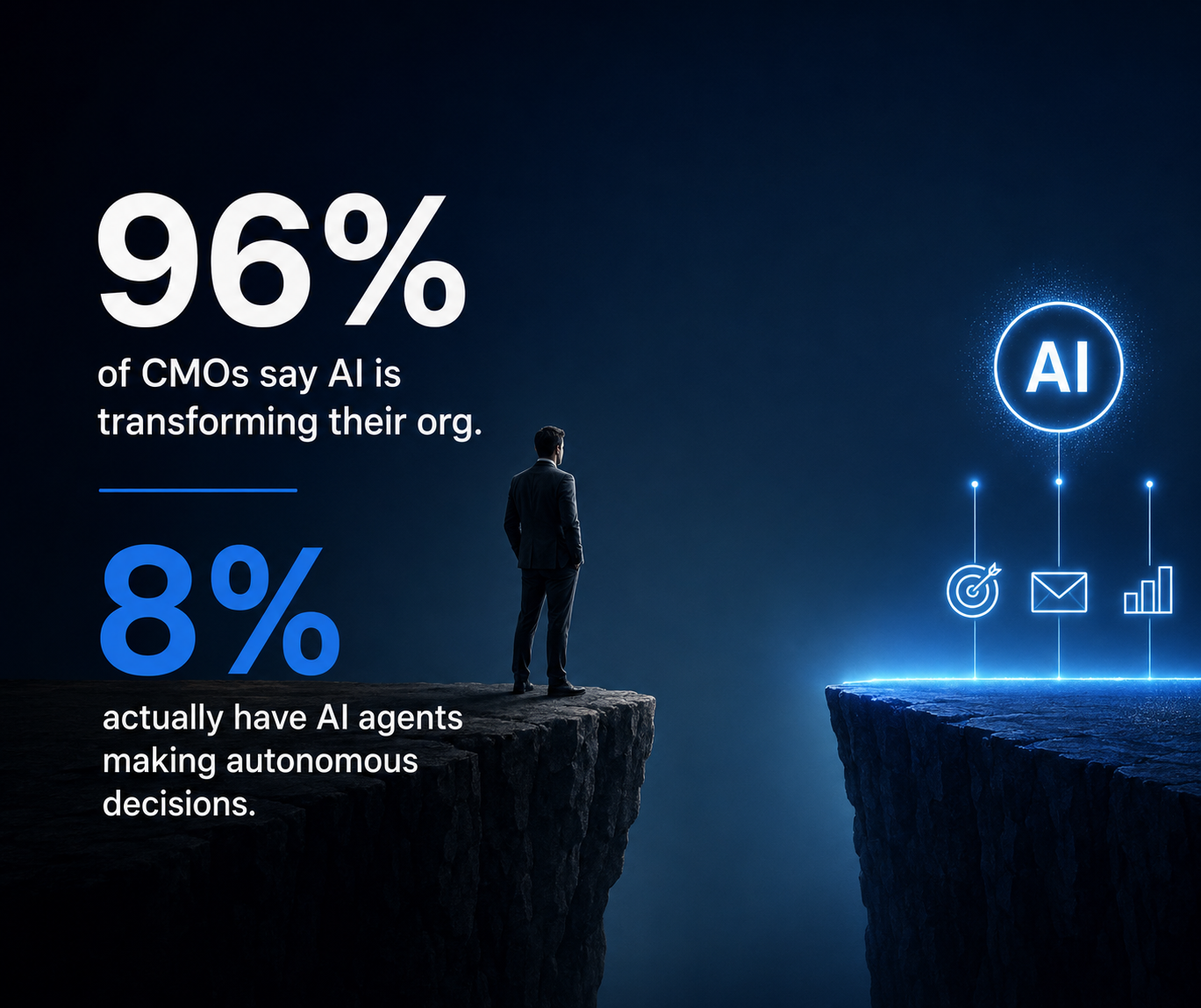
96% of CMOs say AI is transforming marketing. Only 8% have AI agents actually making decisions on their own. That gap says a lot about where we really are - and it isn't a budget problem. It's a trust problem.
- BCG surveyed 300 CMOs: 96% say AI is transforming marketing, but only 8% have AI agents making decisions without a human approving every move.
- The money grows, the autonomy doesn't - 43% of companies now spend more than $15M a year on AI, up from 28% last year, yet most are paying to do the same work faster.
- Martech's share of marketing budgets slipped from 22.4% to 19.4% while more than half of marketers increase spend on usage-based AI tools - often a pricing shift, not a transformation.
- The real blocker is trust: most teams still won't let AI adjust bids, pause campaigns, launch emails, or kill losing creative without a human watching.
- A quieter shift is underway - LinkedIn's research shows AI vendor recommendations are increasingly shaped by reviews, peer conversations, and expert mentions, making brand credibility part of AI discovery.
The gap nobody names
The headline number sounds like a victory lap. BCG surveyed 300 CMOs this month and found that 96% say AI is transforming marketing. Read that in isolation and you'd assume the industry has crossed over - that AI is already running the show.
Then you look one line down. Only 8% have AI agents actually making decisions on their own. Almost everyone says AI is changing how they work, yet fewer than one in ten has AI running campaigns without a human approving every move. That's the gap that actually describes where we are: near-universal adoption sitting on top of near-total human oversight. AI is in the room. It just isn't allowed to touch anything.
The money says the same thing
If adoption were really turning into autonomy, the budgets would show it. They show the opposite. 43% of companies now spend more than $15 million a year on AI, up from 28% last year. Spending is climbing fast - but autonomy isn't climbing with it. In a lot of cases, companies are paying for people to do the same work a little faster, not for AI to take ownership of meaningful decisions.
The martech picture tells the same story from another angle. Martech's share of marketing budgets fell from 22.4% to 19.4%, while more than half of marketers say they're increasing spend on usage-based AI tools. That's not necessarily transformation. Often it's just a different pricing model - the same activities, metered differently, with a shinier label.
Not a budget problem - a trust problem
The biggest misconception I hear is that AI adoption is a budget problem. It isn't. There's clearly money in the system, and it's growing. The thing that's missing can't be bought with a bigger line item.
It's trust. Most organizations still aren't comfortable letting AI adjust bids, pause campaigns, launch emails, or kill losing creative without a human watching over it. Every one of those is a reversible, bounded decision a good operator makes dozens of times a week - and they're exactly the decisions teams keep behind an approval gate. Until that changes, AI stays an assistant. It drafts, it suggests, it waits. It never becomes a real operator.
From assistant to operator
The distinction matters more than it sounds. An assistant compresses the work; an operator owns the outcome. When a human has to sign off on every bid change and every paused ad, the speed you paid for evaporates at the approval step - you've bought a faster engine and left the handbrake on.
Moving from assistant to operator isn't a technology upgrade. The models are already capable enough for most of these decisions. It's a trust decision, and it's earned the way you'd earn it with a new hire: start with the low-risk, reversible actions, set clear guardrails and kill switches, watch the results, and widen the mandate as the track record builds. The teams that never start that process never get past "AI helped us draft it."
The quieter shift: brand credibility becomes AI discovery
There's another shift happening that's getting even less attention. According to LinkedIn's research, AI-generated vendor recommendations are becoming increasingly influenced by customer reviews, peer conversations, and expert mentions. The signals that used to build your reputation the slow way are now also shaping what AI recommends when a buyer asks it to shortlist vendors.
That quietly changes the job. Brand credibility is becoming part of search and discovery inside AI systems, not just a PR function. If reviews, peer sentiment, and expert mentions are the raw material AI pulls from, then reputation is now an input to the algorithm that decides whether you make the list at all. Showing up in the AI's answer is the new version of ranking on the first page.
What the leaders do differently
The companies that pull ahead over the next few years won't necessarily be the ones that spend the most on AI. They'll be the ones willing to let AI make real decisions, learn from its mistakes, and improve over time - while everyone else keeps a human hovering over every move and calls it caution.
Right now, there's no shortage of AI spending. There's a shortage of AI trust. Close that gap deliberately - a little more autonomy, on reversible decisions, with guardrails you can actually see - and the budget you're already spending starts doing something it currently isn't: operating.
FAQ
Why do 96% of CMOs say AI is transforming marketing but only 8% let it make decisions?
BCG surveyed 300 CMOs and found near-universal agreement that AI is changing how marketing works, but fewer than one in ten has AI agents running campaigns without a human approving every move. The blocker isn't capability or budget - it's trust. Most organizations aren't yet comfortable letting AI adjust bids, pause campaigns, or kill creative on its own, so AI stays an assistant instead of becoming an operator.
Is slow AI adoption in marketing a budget problem?
No. Spending is rising fast - 43% of companies now spend more than $15 million a year on AI, up from 28% last year. The constraint is trust, not money. Companies are largely paying to do the same work faster instead of letting AI own meaningful decisions, which is why bigger budgets haven't translated into more autonomy.
What does it mean for AI to be an operator instead of an assistant?
An AI assistant drafts and recommends while a human approves every action. An AI operator is trusted to act inside guardrails - adjusting bids, pausing underperforming campaigns, launching emails, and killing losing creative on its own, then learning from the outcome. The shift from assistant to operator is a trust decision, not a technology upgrade.
How is AI changing brand discovery and vendor recommendations?
According to LinkedIn's research, AI-generated vendor recommendations are increasingly shaped by customer reviews, peer conversations, and expert mentions. The same reputation signals that used to drive word of mouth now influence what AI systems recommend - which means brand credibility is becoming part of search and discovery inside AI, not just a PR concern.
What will separate the companies that win with AI over the next few years?
Not who spends the most. The companies that pull ahead will be the ones willing to let AI make real decisions, learn from its mistakes, and improve over time - starting with low-risk, reversible actions and expanding autonomy as trust is earned. Right now there's no shortage of AI spending; there's a shortage of AI trust.
If you're deciding where to hand AI real ownership - and where to keep a human in the loop - I'd be glad to compare notes.