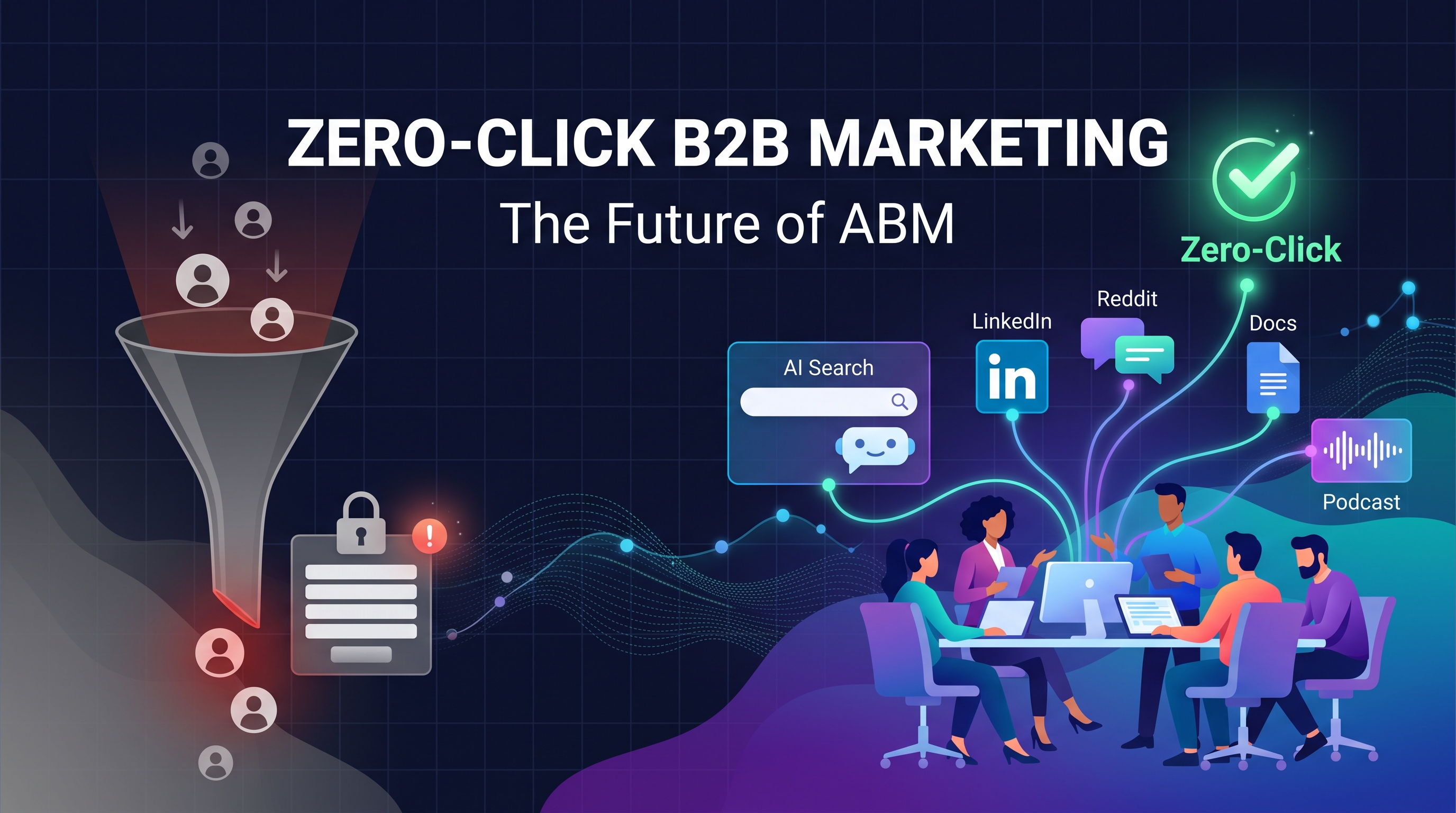
The B2B buyer journey is changing. AI search, peer recommendations, and dark social increasingly shape vendor decisions before a buyer ever fills out a form. Here’s what CMOs should do about it.
- B2B buyers increasingly use AI search, LinkedIn, communities, reviews, and peer conversations before filling out a form.
- The MQL still matters, but it no longer captures the full B2B buying journey.
- Zero-Click Buying Group ABM focuses on influencing the entire buying committee before the first sales interaction.
- Ungate useful expertise: frameworks, benchmarks, research, comparisons, and educational content.
- Optimize content for both traditional search and AI discovery through clear, authoritative, structured information.
- Build demand through executive voices, subject-matter experts, communities, and peer-led distribution.
- Track account engagement and buying-group coverage, not just individual leads.
- Shift measurement toward qualified opportunities, pipeline velocity, and revenue impact.
- The goal isn't more form fills, it's becoming part of the conversation before the buyer is ready to click.
For years, B2B marketing ran on a fairly simple exchange:
Give us your email address, and we’ll give you the whitepaper.
Then the MQL went into a marketing automation sequence, an SDR followed up, and everyone watched the funnel.
It worked.
Until buyers changed.
Today, an enterprise buyer can ask ChatGPT, Perplexity, Gemini, Google AI Mode, Reddit, LinkedIn, or an industry community to compare vendors, explain technical differences, identify implementation risks, and summarize customer sentiment — often without ever visiting a vendor's website.
That changes the job of marketing.
The question is no longer simply:
“How many leads did we generate?”
It is becoming:
“How often does our company appear when the right buying group is researching a problem we solve?”
That is the beginning of zero-click B2B marketing.
And it has major implications for ABM, demand generation, content strategy, SEO, and revenue operations.
What Is Zero-Click B2B Marketing?
Zero-click marketing describes a buying journey where a prospect gets meaningful information about your company, category, product, or expertise without necessarily clicking through to your website.
The information might come from:
- An AI-generated answer
- A Google AI search result
- A LinkedIn post
- A Reddit discussion
- An industry newsletter
- A podcast
- A community recommendation
- A customer review
- A technical documentation page
- A comparison article
- A peer conversation
The click still matters.
But the click is no longer the entire story.
A buyer can encounter your positioning, expertise, customers, product capabilities, and reputation multiple times before they ever raise their hand.
That means demand generation increasingly happens before attribution begins.
And that is uncomfortable for traditional marketing dashboards.
---
The B2B Buying Journey Has Become More Invisible
The old funnel assumed that marketing could observe most of the journey.
A buyer searched Google.
They clicked an ad.
They downloaded an ebook.
They became an MQL.
They attended a webinar.
They requested a demo.
Sales took over.
The modern buying journey is much messier.
A buying committee might:
- Ask an AI assistant which vendors are credible.
- Read technical documentation.
- Search for customer experiences.
- Ask peers on LinkedIn or Slack.
- Browse Reddit discussions.
- Compare pricing and implementation requirements.
- Watch product videos.
- Read independent reviews.
- Talk to a salesperson.
- Return to AI search with more specific questions.
- Finally, visit the vendor website.
Marketing may only see steps 9–12.
The other steps still influenced the purchase.
This is one reason B2B attribution increasingly feels disconnected from reality.
The CRM captures the lead. It doesn't necessarily capture the demand that created the lead.
---
AI Search Is Becoming Part of the Buying Committee
One of the biggest changes in B2B marketing is that buyers can now outsource parts of their research to AI.
Instead of opening 15 browser tabs, a buyer might ask:
> Which enterprise cybersecurity platforms support this architecture?
Or:
> Compare these vendors based on implementation complexity, integrations, compliance, and customer feedback.
Or:
> What should we ask vendors during the procurement process?
Those questions create a new visibility problem.
Your competitors aren't only competing for Google rankings anymore.
They're competing to become part of the answer.
This is where Generative Engine Optimization, or GEO, becomes strategically important.
The objective isn't simply to rank for a keyword.
It's to create information that search engines and AI systems can understand, connect, evaluate, and potentially surface when someone researches your category.
That requires more than publishing generic blog posts.
It requires genuine expertise.
---
Why Gating Everything Can Work Against You
I'm not arguing that every piece of content should be ungated.
Forms still have a purpose.
If someone wants a personalized assessment, pricing consultation, demo, implementation workshop, or enterprise report, exchanging information can make sense.
The problem is gating everything valuable.
Imagine publishing your best benchmark behind a form.
Your strongest research is hidden.
Your most interesting methodology is hidden.
Your proprietary framework is hidden.
Your practical implementation guide is hidden.
The prospect sees a landing page asking for six fields.
Meanwhile, your competitor publishes a detailed version of the same thinking openly.
From a traditional demand-generation perspective, you captured a lead.
From a discovery perspective, you may have lost the opportunity to become part of the buyer's research.
This is the fundamental tension between lead capture and market visibility.
The answer isn't necessarily "never gate content."
The better question is:
What should we make discoverable, and what should we reserve for high-intent interactions?
---
The New CMO Question: What Should Be Ungated?
I'd start with the information buyers need before they're ready to talk to sales.
That can include:
Category education
Explain the problem clearly.
If your market is complicated, become one of the companies buyers trust to understand it.
Frameworks
Publish your methodology.
Don't just say you have a proprietary framework. Explain how it works.
Benchmarks
If you have original data, make the important findings accessible.
Original research can become one of your strongest sources of search and AI visibility.
Comparison content
Help buyers understand the differences between approaches, architectures, and solutions.
Don't hide behind vague positioning.
Implementation guidance
Tell buyers what actually changes when they adopt the category.
What does implementation require?
What integrations matter?
Where do projects fail?
What should procurement ask?
Pricing context
Where possible, give buyers useful pricing guidance instead of forcing them to submit a form just to understand whether your product is remotely within budget.
Transparency can qualify demand as effectively as a form.
---
Buying Group ABM Is Bigger Than Lead Generation
This is where ABM needs to evolve.
The classic ABM model often focused on identifying target accounts and finding the right contacts.
That's still useful.
But enterprise purchases rarely belong to one person.
There may be:
- A business sponsor
- A technical evaluator
- A security team
- Procurement
- Finance
- Legal
- An executive decision-maker
- End users
- Internal champions
Each person has different questions.
The CMO's job is increasingly to make sure the company has credible answers for the entire buying group.
That means your content strategy shouldn't ask:
“What ebook will generate more MQLs?”
It should ask:
“What questions will this buying committee ask before they feel comfortable buying?”
Then build the content around those questions.
---
Step 1: Build a Zero-Click Content Layer
Your website should contain a layer of genuinely useful information that doesn't require a form.
Think:
Question → Answer → Evidence → Experience → Next step
For example:
Question: How difficult is enterprise implementation?
Answer: Give a clear explanation.
Evidence: Provide benchmarks, documentation, or customer evidence.
Experience: Explain what tends to go wrong.
Next step: Offer a deeper assessment, demo, calculator, or conversation.
This structure works for humans.
It also gives search engines and AI systems clearer information to understand.
---
Step 2: Write for Questions, Not Just Keywords
Traditional SEO often starts with:
What keyword should we rank for?
The newer question is:
What question will the buyer ask?
Those are not always the same.
A buyer might search for:
“enterprise identity management software”
But ask an AI assistant:
“Which identity platforms are easiest to integrate with our existing infrastructure?”
The second question reveals much more about buying intent.
Your content should answer both.
This is where SEO, GEO, and customer research increasingly overlap.
Talk to sales.
Talk to customer success.
Read support tickets.
Listen to sales calls.
Review lost-deal notes.
Look at community conversations.
Those sources reveal the questions buyers actually ask.
---
Step 3: Treat Executive and Employee Voices as Distribution
Your corporate website is only one channel.
Your people are channels too.
A technical leader explaining an architecture problem on LinkedIn may reach an audience that would never download a corporate whitepaper.
An engineer explaining an implementation lesson can build credibility with another engineer.
A CMO sharing what actually worked, and what didn't, can create conversations with other executives.
This is part of what people often call dark social.
You may not know exactly where the influence originated.
Someone sees a post.
They send it to a colleague.
The colleague mentions it in a meeting.
A buying committee researches the company.
Eventually someone visits the website.
The CRM sees the final interaction.
It doesn't see the entire chain.
That's not a reason to ignore it.
It's a reason to measure the business differently.
---
Step 4: Connect Intent Signals Without Pretending They Are Perfect
There is a temptation in modern B2B marketing to believe that technology can identify every anonymous buyer.
It can't.
Intent data is useful, but it is not magic.
A company visiting your pricing page doesn't automatically mean a buying committee is ready to purchase.
An employee reading five blog posts doesn't necessarily represent an opportunity.
Good RevOps teams combine signals rather than treating one behavior as proof of intent.
Look for patterns:
- Multiple people from the same account engaging
- Repeated visits to high-intent content
- Pricing or implementation research
- Product documentation activity
- Demo engagement
- Webinar participation
- Sales conversations
- Review-site activity
- Expansion or renewal signals
The goal isn't to predict the future perfectly.
It's to give sales and marketing a better picture of account-level momentum.
---
Step 5: Replace Lead Volume With Revenue Signals
This may be the hardest change for marketing teams.
MQL volume is easy to report.
Revenue influence is harder.
But if the buying process has changed, the measurement system needs to change with it.
Instead of obsessing over:
“How many leads did we generate?”
I'd look at questions such as:
Qualified Account Engagement
Are the right accounts actually engaging with the company?
Buying Group Coverage
How many relevant stakeholders within a target account are engaged?
Pipeline Velocity
Are engaged accounts moving through the buying process faster?
Opportunity Creation
Which marketing activities are associated with qualified opportunities?
Pipeline Influence
Which programs consistently appear around meaningful opportunities?
Cost per Qualified Opportunity
How much does it cost to create genuine sales opportunities rather than contacts?
These metrics connect marketing activity much more closely to revenue.
---
The MQL Isn't Dead. The MQL Is Just No Longer Enough.
This distinction matters.
MQLs can still be useful operationally.
A person filling out a demo form is still a valuable signal.
The problem begins when the MQL becomes the definition of demand.
It isn't.
Demand existed before the form.
The buyer may have spent weeks researching the category.
They may have discussed the problem internally.
They may have asked AI tools for recommendations.
They may have read customer reviews.
They may have followed your executives.
They may have watched three product videos.
Then they finally filled out the form.
The form didn't create all that demand.
It merely made some of it visible.
That's a very different way to think about marketing attribution.
---
What CMOs Should Do Now
If I were rebuilding a B2B demand engine today, I'd focus on five things.
1. Audit your best content
Identify the information buyers need most.
Ask how much of it is hidden behind forms.
2. Map the buying committee
Stop building content exclusively around personas.
Map the actual questions asked by every important stakeholder in the buying process.
3. Build an AI-visible knowledge layer
Make your expertise easy to understand, crawl, reference, and verify.
Use clear HTML, descriptive headings, structured information, original research, expert authorship, and strong internal linking.
4. Invest in human distribution
Build executive voices.
Empower subject-matter experts.
Create useful content for communities rather than constantly pushing people toward landing pages.
5. Change the dashboard
Keep MQLs if they help operations.
But put account engagement, buying-group coverage, opportunity creation, pipeline velocity, and revenue alongside them.
Because the goal isn't to generate more form fills.
The goal is to create more informed buying groups that choose to engage with your company.
---
The New B2B Marketing Advantage Is Being Useful Before You Are Needed
This is the bigger shift.
The strongest B2B brands won't necessarily be the companies publishing the most content.
They'll be the companies whose expertise keeps showing up when buyers have important questions.
Before the demo.
Before the RFP.
Before procurement.
Before the sales call.
Before the buyer even knows which vendors they should consider.
That means marketing increasingly has two jobs:
Create demand.
And become part of the information environment where demand is formed.
Zero-click discovery doesn't mean clicks no longer matter.
It means the click is only one moment in a much larger journey.
And for CMOs, that's the opportunity.
Stop optimizing only for the moment someone raises their hand.
Start building a brand, knowledge base, and buying-group experience that influences the conversation before they do.
That is where modern ABM is heading.
And that is where the next generation of B2B demand generation will be built.
---
Final Takeaway
The future of B2B marketing isn't zero clicks.
It's zero dependence on the click as the only proof that marketing is working.
The companies that win attention in the next phase of B2B growth will make their expertise discoverable wherever buying decisions beginת search engines, AI assistants, communities, social networks, review platforms, and conversations between peers.
The form still has a place.
It just shouldn't be the center of the strategy.
FAQ
What is zero-click B2B marketing?
Zero-click B2B marketing is a demand-generation approach where buyers can discover and evaluate a company's expertise, products, and reputation without necessarily clicking through to its website. AI search, social platforms, communities, reviews, and other third-party sources can all influence the buying journey.
What is buying group ABM?
Buying group ABM is an account-based marketing approach that focuses on the broader group of stakeholders involved in a B2B purchase rather than treating a single lead as the account's primary buying signal.
Is the MQL dead?
No. MQLs can still be useful as an operational marketing metric. The larger change is that MQLs are no longer sufficient as a complete representation of B2B demand. Account engagement, buying-group coverage, pipeline creation, and revenue outcomes provide additional context.
What is GEO in B2B marketing?
Generative Engine Optimization, or GEO, is the practice of creating and structuring content so that generative AI and search systems can better understand, retrieve, summarize, and potentially reference a company's information.
Should B2B companies stop gating content?
Not necessarily. High-value content should be evaluated based on its role in the buying journey. Educational content and foundational expertise often benefit from being publicly accessible, while personalized assessments, consultations, demos, and other high-intent experiences can still justify information exchange.
How can B2B marketers measure zero-click demand?
Zero-click demand is difficult to measure perfectly because many discovery interactions happen outside owned channels. Useful signals include branded search growth, direct traffic, account engagement, buying-group coverage, social engagement, community mentions, sales-reported discovery sources, opportunity creation, and pipeline velocity.
How does AI search change B2B SEO?
AI search expands the objective beyond traditional rankings. B2B companies increasingly need content that clearly answers buyer questions, demonstrates expertise, provides evidence, and is structured so that search and AI systems can understand the information.
If your B2B marketing still measures demand mainly through MQLs and form fills, I’d be happy to compare notes on how to build a buying-group, AI-visible demand engine that connects marketing activity to pipeline and revenue. Let's Talk.