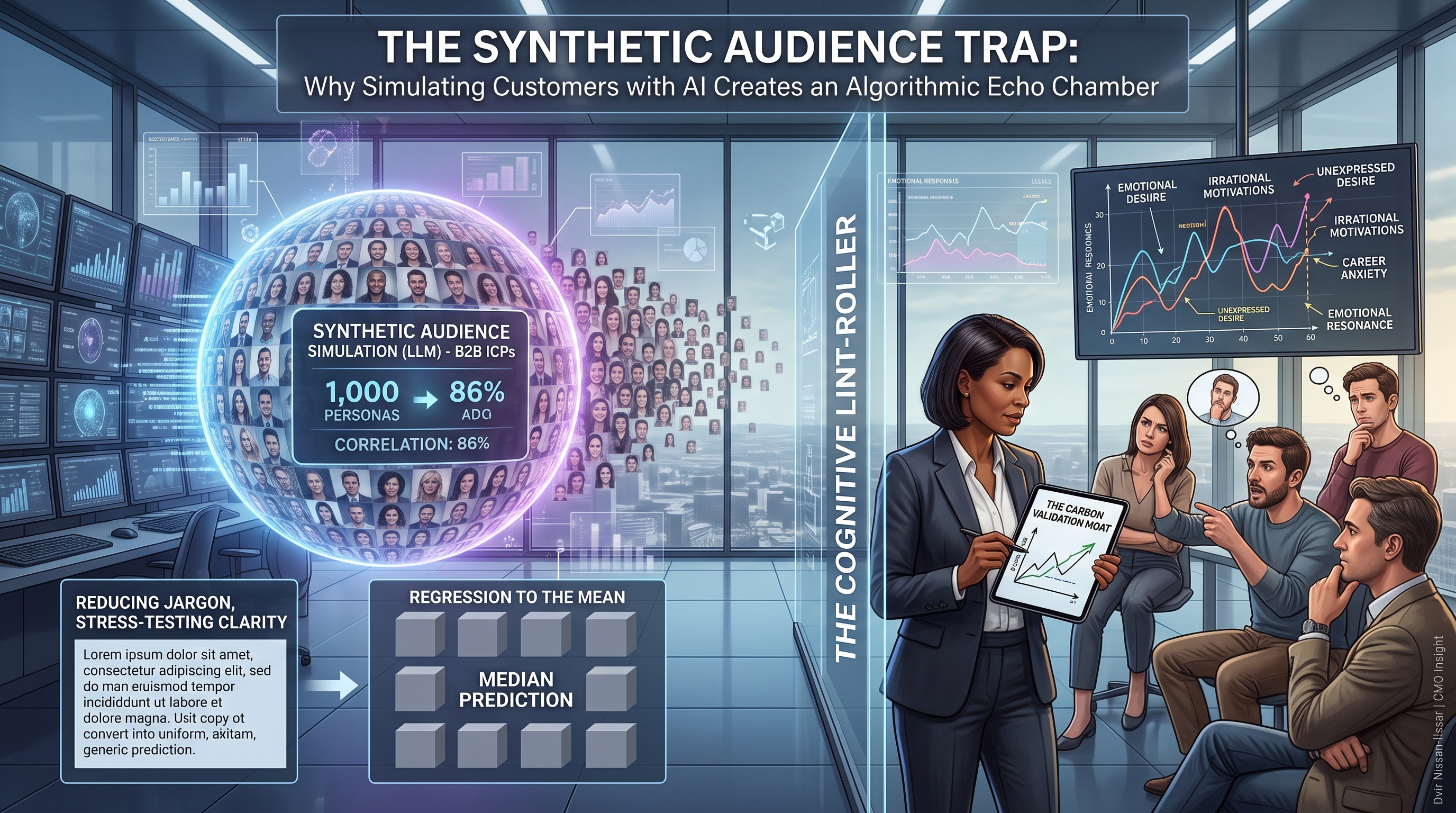
AI can test your messaging in minutes. But should you let it decide what your customers will believe?
- Use synthetic audiences for clarity, not conviction.
- AI is excellent at finding jargon, confusion, missing information, and obvious objections.
- Don't rely on synthetic personas to determine emotional resonance, willingness to pay or category-defining positioning.
- The safest message isn't necessarily the strongest message.
- Differentiation often requires being willing to polarize the wrong audience.
- Use AI to pressure-test the mechanics before involving real customers.
- Use real buyers to understand risk, emotion, internal politics and actual purchase behavior.
- Treat your customers' own language as proprietary marketing intelligence.
- The CMO still needs to make the final positioning decision.
- AI can clean the message. Humans create the meaning.
The CMO problem nobody is talking about
There is a very tempting promise being made to marketing leaders right now:
Why spend weeks recruiting customers for research when AI can simulate thousands of them in minutes?
Give an AI platform your ICP, industry, job title, company size, pain points and buying context. Then ask it to evaluate your landing page, campaign concept, positioning or creative.
You can test dozens of messages before spending a dollar.
As a CMO, that sounds fantastic.
I want faster research. I want fewer expensive research projects that end with a 70-slide PowerPoint nobody opens again. I want my team to pressure-test ideas before they put them in front of customers.
But there is a problem.
The thing that makes synthetic audiences so useful can also make them dangerous.
AI is exceptionally good at telling you whether something makes sense.
It is much less useful at telling you whether something will make a human being care.
And those are two very different marketing questions.
Synthetic audiences are incredibly useful. Until they aren't.
Let's start with the obvious.
Traditional customer research can be painfully slow.
Recruiting the right enterprise buyers takes time. Incentives cost money. Scheduling interviews is painful. Participants cancel. Research projects get delayed. By the time the findings come back, the campaign may already have moved on.
Synthetic audience tools attack exactly that problem.
You can create simulated personas and ask them questions almost instantly.
Does this headline make sense?
Is this positioning clear?
Which benefit is easiest to understand?
What objections might an IT leader raise?
Does this page contain confusing language?
Those are genuinely useful questions.
In fact, I think every serious marketing team should be using AI to answer more of them.
But there is a line I would draw very carefully:
Use synthetic audiences to remove friction. Don't use them to remove your point of view.
That distinction matters enormously.
AI is very good at finding confusion
Imagine you're launching a new cybersecurity product.
Your headline says:
> "An autonomous security intelligence layer for distributed infrastructure."
You put it through an AI audience.
The response comes back:
- The language is too technical.
- The value proposition isn't immediately obvious.
- The buyer may not understand what "security intelligence layer" means.
- The headline doesn't communicate the business outcome.
Great.
That's useful.
You probably have a messaging problem.
AI can act like a very fast editorial partner. It can find jargon, awkward phrasing, missing context, confusing navigation, and obvious objections.
I think of this as cognitive lint-rolling.
Before you put something in front of a real customer, let the machines find the lint.
That's an excellent use of synthetic audiences.
The problem starts when we ask them a different question:
"Is this idea exciting?"
Or:
"Would you buy this?"
Or:
"Does this positioning make us meaningfully different?"
Now we're asking AI to judge something much more complicated.
And that's where marketers need to be careful.
Your best positioning probably won't appeal to everyone
The best brands don't necessarily make everyone comfortable.
They make the right people feel understood.
That distinction gets lost very quickly when you optimize messaging through synthetic audiences.
A conventional message might say:
> "A smarter, faster and more efficient way to manage your infrastructure."
Almost nobody will object to that.
It's clear.
It's professional.
It's safe.
And it's completely forgettable.
Now imagine a challenger brand says:
> "Your infrastructure team doesn't need another dashboard. It needs fewer things to manage."
That's more opinionated.
Some people may dislike it.
Some may disagree.
But the right buyer might stop scrolling.
That's the point.
Differentiation requires a willingness to be slightly wrong for some people.
If your testing process continuously rewards the message that produces the most agreement, you can accidentally optimize the life out of your brand.
The danger of the synthetic average
This is the part I worry about most as a marketing operator.
Most LLM-based systems are built to generate plausible, probable responses based on patterns in the information they've learned.
That makes them incredibly powerful.
It also means they have a natural gravitational pull toward what sounds familiar.
And familiarity isn't the same thing as differentiation.
Think about what happens when five companies in the same category start using AI to test their positioning.
Company A asks AI what enterprise buyers want.
Company B asks AI what enterprise buyers want.
Company C asks AI what enterprise buyers want.
They may even use different platforms, but underneath the experience there can be substantial overlap in the models, language patterns, and market assumptions being used.
Eventually everyone starts hearing the same advice:
Be clearer.
Be more customer-centric.
Emphasize efficiency.
Reduce friction.
Highlight ROI.
Simplify the headline.
Talk about transformation.
Use social proof.
None of that is bad advice.
But if everyone follows it in exactly the same way, you don't have differentiation anymore.
You have AI-assisted category wallpaper.
The real risk isn't inaccurate research
I don't think the biggest problem with synthetic audiences is that they're always wrong.
That's too simplistic.
The bigger problem is that they can be right in ways that make your marketing worse.
They can correctly identify that your unconventional headline is less familiar.
They can correctly tell you that your provocative positioning may alienate some people.
They can correctly suggest a safer alternative.
And if you optimize every decision against those recommendations, your marketing gradually becomes smoother.
And smoother isn't always better.
Sometimes the thing that makes a customer stop is precisely the thing that wouldn't survive a conventional research process.
The strange phrase.
The uncomfortable question.
The aggressive point of view.
The campaign that makes your sales team slightly nervous.
The positioning that your competitors would never dare to say.
Those things deserve human judgment.
What I would use synthetic audiences for
If I were running the marketing organization, I wouldn't ban synthetic research.
I'd do the opposite.
I'd build it into the workflow.
But I'd give it a very specific job.
1. Use AI to find jargon
Have synthetic personas tell you where your language becomes unnecessarily technical.
Especially in B2B.
Marketing teams often forget how much category language we've absorbed.
Words that feel obvious to us can be completely meaningless to a new buyer.
AI is excellent at finding those moments.
2. Use AI to test comprehension
Show it different versions of your value proposition.
Ask:
- What does this company actually do?
- Who is this product for?
- What problem does it solve?
- What would you expect to happen after buying it?
- What questions remain unanswered?
You're not asking AI to predict revenue.
You're asking it to find confusion.
That's a very different exercise.
3. Use AI to generate objections
This is another strong application.
Before a sales team takes a campaign to market, ask synthetic buyers to attack it.
What sounds unbelievable?
What claim needs evidence?
What information is missing?
What would make someone hesitate?
This can save real buyers from having to explain problems that your team could have caught internally.
4. Use AI for localization checks
Global marketing teams can also get significant value here.
Run messaging through different regional personas and look for obvious linguistic problems, cultural assumptions, or confusing terminology.
Again, the objective isn't to predict the campaign's success.
It's to catch things that shouldn't have made it into production.
What I would never outsource to synthetic audiences
There are some questions where I want real humans.
Full stop.
"Would you buy this?"
I'd ask a real buyer.
"What would stop you from buying?"
I'd ask a real buyer.
"Would you risk your reputation recommending this internally?"
I'd definitely ask a real buyer.
"Does this positioning make you feel something?"
Real buyer.
"Would you switch from the incumbent?"
Real buyer.
"Would you pay more for this?"
Real buyer.
Because buying isn't just an information-processing exercise.
Especially in B2B.
There is budget risk.
Political risk.
Career risk.
Procurement.
Existing vendor relationships.
Internal champions.
Internal blockers.
The person who signs the contract may not be the person who wants your product.
And the person who loves your product may not control the budget.
No synthetic persona can fully recreate the messy organizational reality behind those decisions.
The questions I actually want to ask customers
This is where real research becomes much more valuable.
Instead of asking:
"Do you like this positioning?"
I'd rather ask:
"What's your immediate reaction to this?"
Then shut up.
Let them talk.
I'd ask:
> "What part of this feels believable?"
Then:
> "What part makes you skeptical?"
Then:
> "If you brought this to your boss, what question would they ask?"
And perhaps the most important one:
> "What would make choosing this vendor feel risky?"
Those answers contain something synthetic research cannot easily manufacture:
the customer's actual language.
That language is gold.
It belongs in your website.
Your ads.
Your sales enablement.
Your product roadmap.
Your positioning.
And eventually, your company's institutional memory.
The hybrid model I would use
The answer isn't AI versus humans.
It's AI first, humans where it matters.
Here's the workflow I'd want my team to use.
Step 1: Create the raw idea
Start with the bold version.
Don't ask AI to make it safe yet.
Write the positioning you actually believe.
Write the campaign you'd actually want people to remember.
Write the headline that makes the team debate it.
Step 2: Let AI attack the mechanics
Now bring in synthetic audiences.
Ask them to identify:
- confusing language
- jargon
- unsupported claims
- missing context
- obvious objections
- information hierarchy problems
- unclear calls to action
Fix those problems.
Step 3: Put the improved idea in front of real buyers
Now talk to five to eight relevant customers or prospects.
Not a scripted survey.
A real conversation.
Ask what they think.
Ask what feels wrong.
Ask what they'd repeat internally.
Ask what they'd never say to their boss.
And most importantly, listen for language you didn't put in their mouths.
Step 4: Keep the tension
This is the step marketing teams often skip.
Don't automatically change the positioning because one person didn't like it.
Look for patterns.
Is the message confusing?
That's a problem.
Is the message provocative?
That might be the point.
Those aren't the same thing.
Step 5: Make the final decision like a marketer
Research informs positioning.
It doesn't own positioning.
Someone still needs to decide:
What do we want to stand for?
That's the CMO's job.
Your customer data is becoming more valuable, not less
There is a bigger strategic implication here.
AI is rapidly making content creation cheaper.
It's making research cheaper.
It's making analysis cheaper.
It's making creative iteration cheaper.
That means the information everyone can access becomes less differentiated.
Your real competitive advantage moves somewhere else.
Your proprietary understanding of your customers.
The exact words they use.
The objections they raise.
The internal politics behind their purchases.
The reasons they don't switch vendors.
The thing they're embarrassed to admit.
The moment they finally realize they have a problem.
The language they use when your product solves it.
That's not generic market research.
That's institutional knowledge.
And it compounds.
Every customer interview should make your organization smarter.
Every sales call should teach marketing something.
Every lost deal should improve your understanding of the market.
Every customer should add another piece to the positioning puzzle.
AI can help you process all of that information.
But it shouldn't replace the source.
The CMO rule: AI can clean the message. Humans create the meaning.
I'm bullish on synthetic audiences.
I'm also bullish on knowing where they stop being useful.
Use AI to make your marketing clearer.
Use real customers to make it true.
Use your marketing team to make it different.
That's the combination I would bet on.
Because the goal of customer research isn't to find the message that everyone agrees with.
The goal is to discover the message that makes the right customer say, "That's exactly my problem."
And sometimes, the message that creates that reaction is precisely the one an AI-generated average would tell you to soften.
Don't automatically soften it.
Ask why.
That tension might be where your brand advantage lives.
---
Final CMO takeaway
The biggest danger of AI in marketing isn't that it will make your team less creative.
It's that it will make your marketing slightly more reasonable, slightly more predictable, and slightly more like everyone else's.
And in a market where every competitor has access to the same AI tools, that can become a very expensive form of sameness.
FAQ
Are synthetic audiences useful for marketing research?
Yes. Synthetic audiences can be useful for fast testing of messaging clarity, jargon, information hierarchy, localization, and obvious customer objections. Their greatest value is as a first-pass research and editing tool rather than a replacement for real customer conversations.
What are the risks of synthetic audiences?
The biggest risk is homogenization. If marketers repeatedly optimize messaging against AI-generated personas, they may gravitate toward familiar, safe and broadly acceptable language rather than distinctive positioning that creates strong preference among the right customers.
Can AI replace customer interviews?
AI can reduce the amount of basic research and preparation required, but real customer interviews remain important for understanding emotional reactions, organizational politics, career risk, buying behavior and the language customers naturally use to describe their problems.
When should marketers use synthetic personas?
Use them for comprehension testing, jargon audits, objection generation, information architecture, localization checks and other mechanical tasks. Use real customers for positioning, emotional resonance, willingness to pay, purchase decisions and high-stakes strategic validation.
How should CMOs combine AI and customer research?
A strong workflow is to develop the initial idea, use AI to identify mechanical problems, then take the refined positioning to real customers for qualitative validation. The marketing team should retain responsibility for the final strategic positioning decision.