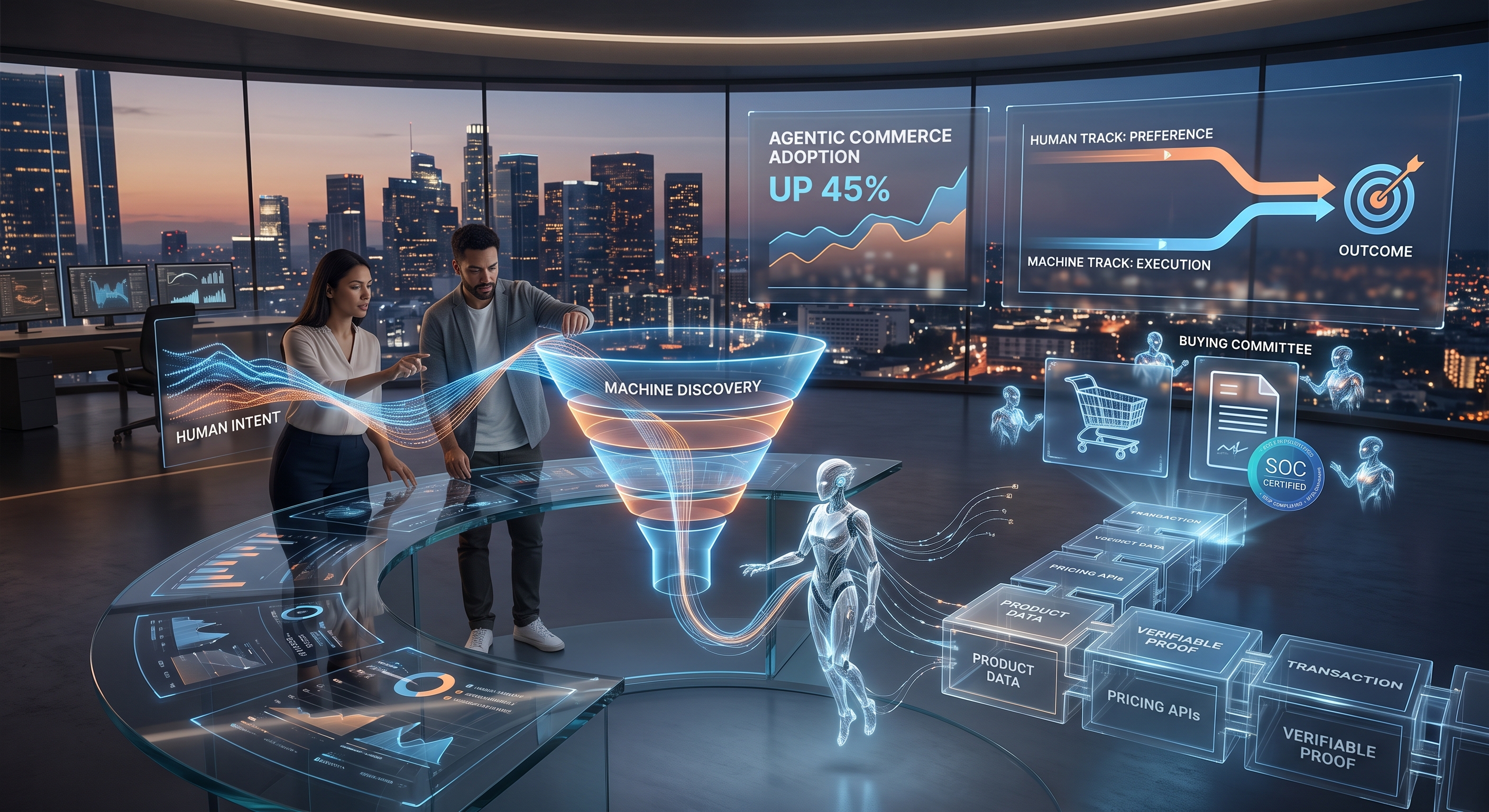
Prepare your brand for the automated interface and the future of commerce.
- The First Touch Is Shifting to AI: Buyers increasingly dispatch autonomous AI agents to research, compare options, and filter vendors before any human ever visits a website.
- The "Pretty Website" Trap: Visual polish, clever copy, and emotional hooks don't register with machines; AI evaluates structured specs, explicit limitations, transparent pricing, and verifiable proof.
- The Rise of Protocol Marketing: Success requires a dual-track strategy, traditional brand building to create human preference, combined with machine-readable infrastructure (clean data, schemas, public docs, and APIs) so agents can discover, verify, and transact with you.
- Transparency Over Friction: Gating basic specs, compliance certifications, or pricing models behind "Book a Demo" forms causes AI agents to bypass you entirely in favor of accessible alternatives.
- Persuasion Meets Execution: The goal of marketing is no longer just convincing a human to click; it is ensuring an AI agent can confidently recommend your product and immediately act on it.
For almost my entire career, marketing rested on one safe, comfortable assumption: there is always a human being on the other end of the line.
We designed the whole machine around human quirks. We picked bold hero images to hook wandering eyes, polished case studies to soothe buyer anxiety, tuned copy to trigger emotional buy-in, and ran relentless A/B tests to scrape every drop of friction out of the checkout flow.
It worked because human brains share the same wiring: we get distracted, we look for social proof, and we respond to urgency.
That assumption is quietly breaking.
Today, the first person checking out your company often isn't a person at all. It’s an AI agent running a workflow. A prompt like, "Find me three SOC 2-compliant CRMs with direct Salesforce sync and clear seat pricing for a 200-person team," doesn't trigger a browsing session across ten open browser tabs. It triggers an automated research sweep.
The plumbing for this is arriving fast. Google’s Universal Commerce Protocol is stitching agent discovery directly to cart creation. Shopify is actively wiring its product catalogs into agentic systems. Meta is driving its Muse AI deep into business workflows.
We aren't in a post-human marketing world yet. But we are undeniably entering an era where your first hurdle isn't convincing a buyer, it's getting past the machine they sent to do the legwork.
Beautiful Websites Don't Impress Large Language Models
Marketers love visual polish. We obsess over typography, micro-interactions, brand color palettes, and video testimonials.
None of that matters to an autonomous agent.
An agent parsing your business doesn't feel moved by your sleek Framer animations or your aspirational hero copy. It strips the page to raw text and structured data, asking relentlessly pragmatic questions:
- What does this tool actually do?
- What are the concrete product limitations?
- Exactly how much does it cost?
- Does it integrate natively via a REST API, or does it require third-party middleware?
- Are the compliance certifications verifiable right now?
- Can I initiate a trial or trigger a sandbox account automatically?
If your site is an aesthetic triumph that hides product specs behind vague buzzwords and gates basic answers behind a "Book a 30-Minute Demo" form, the agent won't stick around to be persuaded. It will simply exclude you and recommend a competitor whose data is cleanly accessible.
Your website is no longer just a digital billboard. Your data has become an interface.
Enter Protocol Marketing
We spent twenty years mastering SEO to help search engines index our keywords. We’re currently wrestling with Generative Engine Optimization (GEO) so models like ChatGPT, Gemini, and Claude mention our brand in answers.
The next frontier goes a layer deeper: Protocol Marketing.
If GEO is about being cited, Protocol Marketing is about being executable. It’s the practice of structuring your company’s commercial data and operational workflows so autonomous systems can understand, verify, compare, and transact with you with zero human intervention required.
It breaks down into three distinct operational layers:
1. Make the Business Legible
Start with basic data hygiene. Stop trapping critical information in locked PDFs, slide decks, or marketing fluff. Use explicit Schema.org markup across your site. Maintain public, machine-readable API documentation (like OpenAPI/Swagger specs). Ensure specs, pricing tiers, and integration lists are published as structured text. Don’t force a model to guess your core functionality from scattered marketing slogans.
2. Make the Claims Verifiable
Every B2B company claims to be "enterprise-grade" and "secure." An AI agent, however, searches for proof. It cross-references public trust centers, active SOC 2 and ISO compliance registries, status pages, verified customer review databases, and open-source repos. Marketing claims that lack third-party verification will simply be ignored or heavily discounted.
3. Make the Product Actionable
Discovery without execution is a dead end. When an agent determines your product is a great fit, what can it actually do next? Can it pull live inventory, spin up a self-serve trial via an API, configure a custom quote, or initiate a transaction? If every path forward dead-ends at a calendar scheduler, you’re introducing human drag into a machine-speed decision loop.
The Dual-Track Reality: Brand for People, Data for Bots
Does this mean brand storytelling, community, and emotional positioning are dead?
Not even close. In fact, real brand equity matters more than ever.
Human intent still drives the entire process. A human executive says: "Find me an enterprise-grade, privacy-first alternative to Loom." That prompt itself is shaped by reputation, word-of-mouth, and brand positioning. That’s your traditional marketing at work—earning the right to be named in the initial prompt.
Once that intent is set, the process splits into two tracks:
``` [ Human Buyer Intent ] │ ├─► Human Track: Brand, Storytelling, Trust, Community (creates the preference) │ └─► Machine Track: Structured Data, APIs, Verifiable Specs, Easy Checkout (executes the preference)
```
The human track creates the initial preference. The machine track ensures that preference doesn't fall apart during technical evaluation.
A Quick Readiness Audit for Your Next Strategy Meeting
If you want to know where your company stands in this shift, look at your current footprint through the eyes of an autonomous agent:
- Machine Legibility: Can a language model accurately describe your core features, target audience, and explicit limitations using only your public-facing web footprint? Or does it hallucinate because your site is buried in vague corporate jargon?
- The "Gatekeeper" Test: How much critical product truth are you hiding behind a sales rep? If basic pricing ranges, technical architecture, and compatibility matrices require a phone call, an agent will skip you in favor of a transparent competitor.
- Verifiable Proof: If your site claims high reliability, fast implementation, or military-grade security, is there an open status page, technical whitepaper, or public compliance link to back it up?
- Handoff Friction: Once someone (or their agent) decides you’re the right fit, how many manual hoops must they jump through before they can actually test, provision, or buy?
The marketing funnel isn't vanishing, but the front door is changing.
Moving forward, your customers won't always experience your brand through a homepage redesign or an email nurture sequence. Increasingly, they’ll experience you as a three-bullet summary generated by an AI assistant that parsed your product specs at 2:00 AM.
Don't abandon creativity, emotional resonance, or human storytelling. Just recognize that persuasion is only half the battle now. The winning brands will be the ones that build an emotional connection people ask for—and the digital infrastructure that machines can actually work with.
FAQ
Is agentic commerce only relevant to B2C e-commerce?
No, not at all. While the initial examples (like Shopify and Google UCP) often focus on retail transactions, the implications for B2B are profound. Complex SaaS procurement involves structured requirements, like specific integrations, SOC 2 compliance, and transparent pricing, which AI agents can filter much faster than a human. If a B2B vendor's basic specs and trust signals aren't machine-readable, they may be screened out before a human buyer ever sees them.
Will Protocol Marketing make our website look like an API manual?
That is a common concern, but the answer is no. Your human website still needs to be intuitive, emotionally resonant, and designed for human conversion. Protocol Marketing is the infrastructure underneath that visible layer. It means using structured data formats (like JSON-LD) and robust, accessible APIs that machines can query directly, while the human interface remains focused on brand storytelling and user experience.
Does Protocol Marketing replace SEO?
Protocol Marketing is an evolution of SEO and GEO. SEO made your content crawlable; GEO makes your knowledge accessible; Protocol Marketing makes your business transactional for AI systems. It expands the definition of discoverability from "ranking high for a keyword" to "being selected by an AI agent to execute a purchase."
What is the single most important asset a company needs for machine readiness?
A structured, verifiable "commercial source of truth." This isn't just a content management system; it's clean product data (specs, capabilities, limitations), transparent pricing structures, accessible API/technical documentation, and a verifiable "trust center" containing your security and compliance certifications.
The brands that master this next era won't abandon human creativity or psychology, they will amplify them by building an operational infrastructure that allows their human preference to be flawlessly executed by machines. Let's Talk.