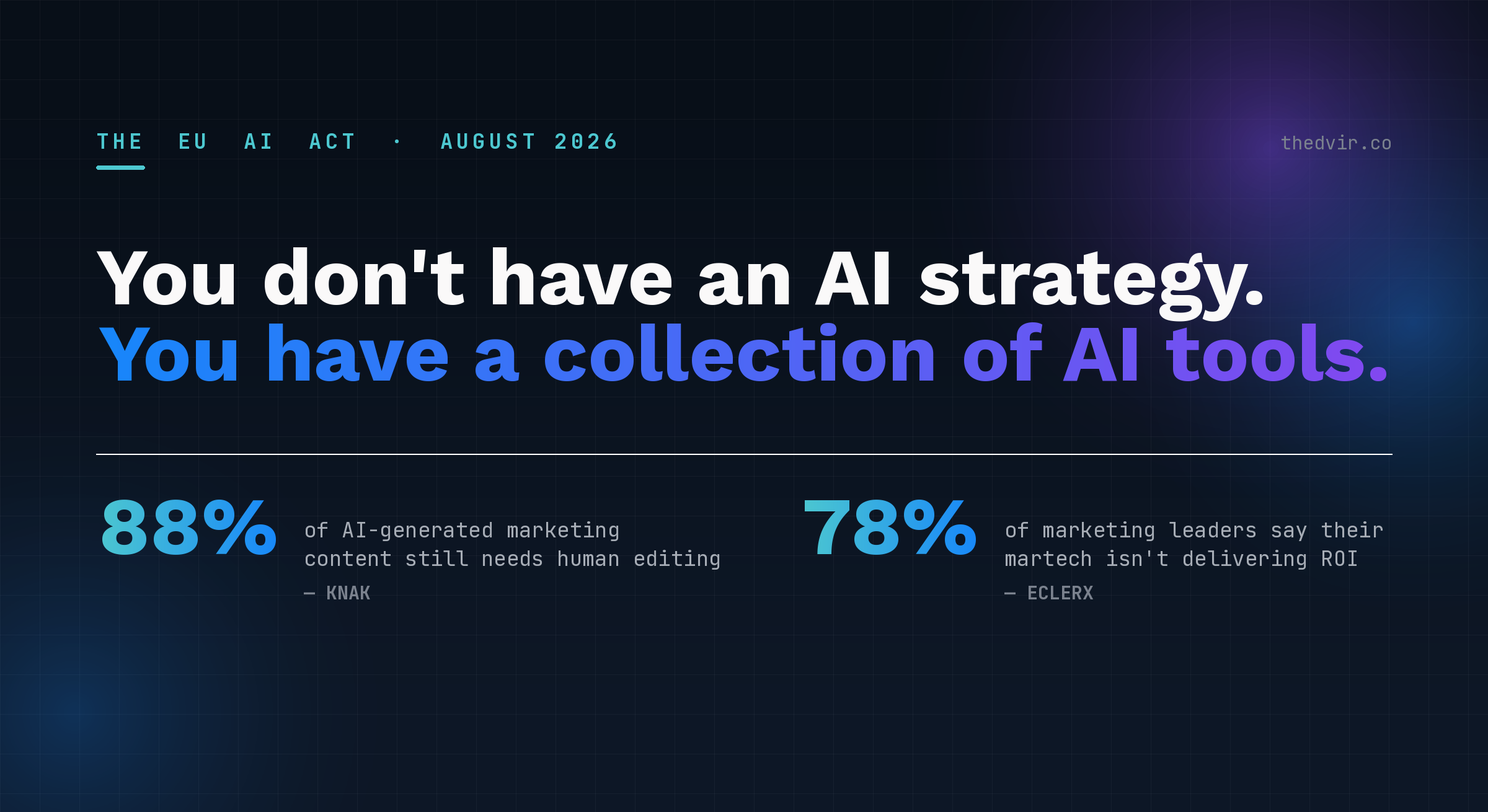
Today the EU AI Act officially begins to apply across the EU. And I think a lot of marketing teams are about to realize they don't really have an AI strategy. They have a collection of AI tools.
- The EU AI Act now applies across the EU. The teams scrambling aren't the ones with the most AI tools - they're the ones who never built a process around them.
- 88% of AI-generated marketing content still needs human editing (Knak) - not because AI writes badly, but because most companies never built a review step.
- 78% of marketing leaders say their martech isn't delivering ROI (eClerx). That's a process problem, not a technology problem.
- The Act forces questions good marketers should already answer: who reviews AI content, who's accountable, can you explain how it was made, is there an audit trail.
- AI didn't eliminate the need for editors. If anything, it made them more valuable than ever.
A collection of tools isn't a strategy
The EU AI Act starting to apply is being read, in a lot of companies, as a legal event - something for the compliance team to work through. I think that framing badly undersells what's actually happening. The Act is going to make a quieter fact impossible to ignore: most marketing teams don't have an AI strategy. They have a pile of AI tools.
There's a real difference. A strategy defines what AI is for, where it's allowed to act, who owns the output, and how you know it's working. A pile of tools is what you get when you add ChatGPT, Claude, or the AI feature bundled into your existing platform and assume the workflow will sort itself out. It won't - and the Act is about to make that gap visible in a way a quarterly review never quite did.
The stat that actually stood out to me
The number I keep coming back to isn't about regulation at all. According to Knak, 88% of AI-generated marketing content still needs human editing. Read quickly, that sounds like a knock on the models. It isn't.
AI isn't bad at writing. The reason nearly nine in ten pieces still pass through a human is that most companies never built a review process to begin with. They dropped a generation tool into the stack and expected the surrounding workflow - briefs, standards, sign-off, feedback - to take care of itself. It didn't. The 88% is the sound of that missing process being paid for manually, one edit at a time.
It's a process problem, not a technology problem
The same pattern shows up in the money. According to eClerx, 78% of marketing leaders say their martech investments aren't delivering ROI. Again, I don't think that's a technology problem. It's a process problem.
You can buy the best tools on the market and still get very little back if there's no workflow around them - no clear ownership, no review, no way to tell a good output from a bad one before it ships. Better software layered on a broken process just produces more output nobody trusts. The tools were never the constraint. The operating model was.
The questions the AI Act forces you to answer
Here's where the regulation and the good-marketing argument collapse into the same thing. A lot of people are treating the EU AI Act like a compliance exercise for legal teams. I think it's much bigger than that, because it forces companies to answer questions they probably should have answered long ago:
- Who reviews AI-generated content? Not in theory - the actual named step and the person who owns it.
- Who is accountable for what gets published? When something goes out under your brand, accountability can't be "the tool did it."
- Can you explain how something was created? Which model, which prompt, which sources, which human decisions along the way.
- Is there an audit trail? A record you could actually show, not a memory of roughly what happened.
Those aren't just compliance questions. They're good marketing questions. A team that can answer all four is a team that trusts its own output - which is exactly what lets it move fast without breaking things in public.
Two kinds of teams
The difference between teams is becoming really obvious. Some treated AI like an unsupervised intern: generate, publish, hope for the best. Others built human review into every AI workflow from day one, because they understood that speed is only valuable if you can trust the output.
Guess which teams are scrambling now. The companies with solid review processes don't have to reinvent how they work because of the AI Act - they're already operating the way regulators expect. The ones that skipped those steps are discovering that moving faster without oversight wasn't an advantage. It was a liability that hadn't come due yet.
AI made editors more valuable, not less
There's a tidy conclusion a lot of people reached over the last couple of years: AI writes the content, so the editors go. The evidence points the other way. AI didn't eliminate the need for editors. If anything, it made them more valuable than ever.
When generation gets cheap and near-instant, the scarce thing becomes judgment - the review, the accountability, the ability to say what's good enough to ship and what isn't. That's the work the 88% is quietly demanding, the work the missing ROI is quietly missing, and the work the AI Act is now formally requiring. The teams that build that judgment into the workflow, on purpose, are the ones the next few years will reward.
FAQ
When does the EU AI Act start to apply?
The EU AI Act entered into force in 2024 and applies in phases rather than all at once, with a significant set of obligations taking effect across the EU in August 2026. The practical takeaway for marketing teams isn't the exact date - it's that transparency, accountability, and human-oversight expectations are now real, not theoretical, and apply to how AI is used to create and publish content.
Does the EU AI Act mean marketing teams can't use AI to create content?
No. The Act doesn't ban AI-generated marketing content. What it pushes for is transparency, clear accountability, and human oversight. In practice that means having a review process, a named owner for what gets published, the ability to explain how something was created, and an audit trail - the same things a well-run marketing team should already have.
Why does 88% of AI-generated marketing content still need human editing?
According to Knak, 88% of AI-generated marketing content still needs human editing. That isn't because AI is bad at writing. It's because most companies never built a review process - they added ChatGPT, Claude, or another tool to the stack and assumed the workflow would take care of itself. It didn't. The editing burden is the symptom of a missing process, not a failure of the model.
Is poor martech ROI a technology problem?
Mostly, no. eClerx found that 78% of marketing leaders say their martech investments aren't delivering ROI. That's rarely a technology problem - it's a process problem. Tools get added without the workflows, ownership, and review steps that turn them into results. Better software on top of a broken process just produces more output nobody trusts.
If you're building the review process your AI stack has been missing - the ownership, the oversight, the audit trail - I'd be glad to compare notes.