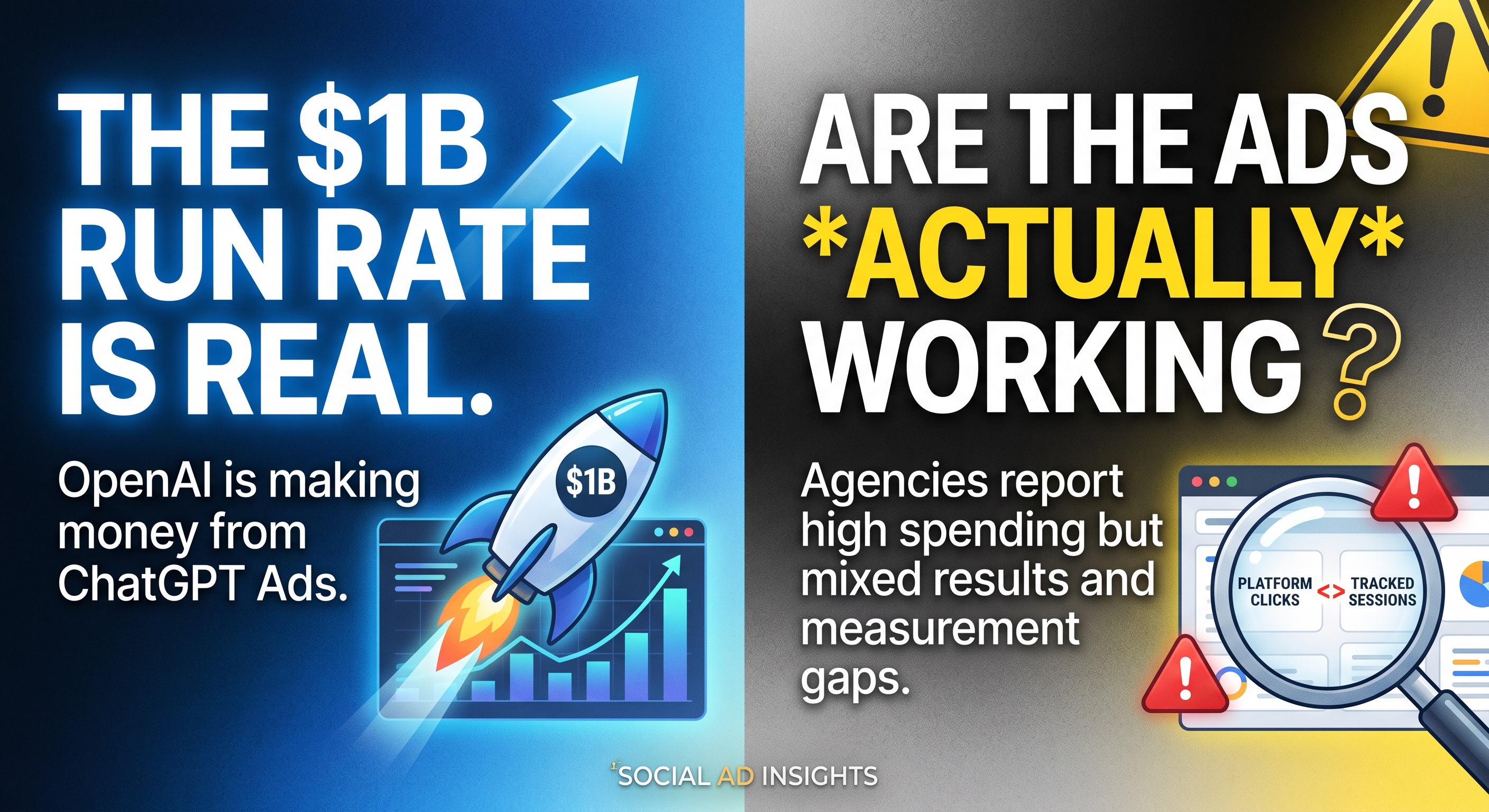
OpenAI’s advertising business is growing at extraordinary speed. But early advertiser data raises a more important question: can marketers actually measure whether ChatGPT Ads are driving revenue?
- ChatGPT Ads have reached a $1 billion annualized revenue run rate in roughly 200 days.
- That proves there is significant advertiser demand for the platform.
- Early agency tests have produced mixed or disappointing conversion results.
- One test reported 57 clicks in OpenAI's dashboard versus fewer than 20 sessions in Google Analytics.
- Another campaign generated roughly 9,000 impressions, 60 clicks and zero buyers from $415 in spend.
- The biggest concern isn't necessarily poor performance. It's measurement confidence.
- ChatGPT Ads should currently be treated as an experimental/research budget, not automatically as a scalable performance channel.
- Marketers should prioritize first-party and server-side attribution over platform-reported metrics.
- Longer term, the bigger opportunity may be earning recommendations and citations inside AI answers, rather than simply buying ads beside them.
A $1 billion annualized revenue run rate tells you that advertisers are willing to spend money.
It does not tell you whether those advertisers are making money.
That distinction is becoming increasingly important as ChatGPT Ads move from experimental new channel to serious line item in marketing budgets.
OpenAI announced this week that ChatGPT Ads had reached a $1 billion annualized revenue run rate in roughly 200 days, with self-serve advertising expanding across more than 40 countries. Forbes reported that OpenAI had reached the milestone after launching its first advertising pilot in February, and the company is targeting $2.5 billion in advertising revenue this year.
On the surface, this looks like the arrival of a new advertising giant.
And maybe it is.
But there is another story happening at the same time.
Agencies testing ChatGPT Ads are reporting weak conversion performance, low engagement and, more concerningly, discrepancies between the numbers reported by OpenAI and the numbers showing up in their own analytics.
For marketers, that second story matters more.
ChatGPT Ads Are Growing Extremely Fast
Let's start with the part that is genuinely impressive.
OpenAI says ChatGPT Ads have gone from zero to a $1 billion annualized revenue run rate in approximately 200 days.
Self-serve advertising is also expanding internationally, giving more advertisers direct access to the platform rather than requiring an agency or managed relationship.
From OpenAI's perspective, this is a phenomenal result.
Advertising creates a second major monetization engine alongside ChatGPT subscriptions, enterprise revenue and API usage.
And the scale of the audience makes the opportunity obvious.
ChatGPT is no longer simply an AI experiment used by a relatively small group of early adopters. It has become a major destination for information, research, recommendations and decision-making.
That makes it incredibly attractive to marketers.
But there's an important distinction:
A platform can be an incredible business for its owner before it becomes an incredible acquisition channel for its advertisers.
Google was a great business before every advertiser figured out how to optimize Google Ads.
Meta was a great business before marketers fully understood Facebook's targeting and attribution.
TikTok went through the same learning curve.
ChatGPT Ads will likely go through one too.
---
The Early ChatGPT Ads Results Are Not Exactly Convincing
This is where the story gets more interesting.
MediaPost recently reported on several agencies that tested ChatGPT Ads and weren't seeing the performance they expected.
One Canadian agency spent $415 across three campaigns.
The expectation was around 4,000 impressions.
The campaigns delivered almost 9,000 impressions.
That sounds good until you look at what happened next.
The campaign generated approximately 60 clicks, producing a CTR of about 0.6%.
The agency's comparison point was roughly 2% for search advertising.
Estimated CPC was around $7.
And the most important number?
Zero buyers.
That's not enough data to conclude that ChatGPT Ads don't work.
The sample is tiny.
The campaigns were early.
The targeting capabilities available at the time were limited.
And comparing a new conversational advertising format directly with mature search advertising isn't necessarily apples-to-apples.
But it is enough to say:
Don't confuse impressions and clicks with performance.
---
The Measurement Problem Is More Interesting Than the Performance Problem
This is the part that would make me uncomfortable as a CMO.
Another B2B agency tested ChatGPT Ads and reportedly saw reasonable click-through rates but no conversions.
More importantly, the agency found a discrepancy between OpenAI's reporting and Google Analytics.
OpenAI reported 57 clicks.
Google Analytics showed fewer than 20 visits from the campaign, despite UTMs being implemented.
That's a very different problem from having a bad CTR.
If your CTR is poor, you have something to optimize.
You can change:
- Creative
- Targeting
- Audience
- Messaging
- Bids
- Landing pages
- Offers
- Conversion flows
But if you don't trust the underlying measurement, you don't know what you're optimizing.
And that's dangerous.
Because the worst thing that can happen to a performance marketer isn't necessarily a campaign that doesn't work.
It's a campaign where you can't confidently determine whether it worked.
---
Performance Problems Can Be Fixed. Measurement Problems Are Harder.
This is the distinction I think marketers should pay attention to.
Performance problem
Your ad generates clicks but doesn't convert.
That's frustrating.
But it's diagnosable.
Maybe the audience is wrong.
Maybe the creative is weak.
Maybe the landing page sucks.
Maybe the offer isn't compelling.
Maybe the intent isn't commercial enough.
You can test all of those things.
Measurement problem
Your advertising platform says you generated 57 clicks.
Your analytics platform says you received fewer than 20 sessions.
Now what?
Which number goes into your CAC calculation?
Which number goes into your channel attribution?
Which number gets reported to the CFO?
Which number do you use to decide whether to increase the budget?
That's not a creative optimization problem.
It's a data integrity problem.
And data integrity is the foundation of performance marketing.
---
This Isn't Proof That ChatGPT Ads Are Bad
It's important not to overreact.
I don't think the lesson here is:
"ChatGPT Ads don't work."
We simply don't have enough evidence to make that claim.
The platform is incredibly young.
OpenAI has been adding capabilities quickly, including geotargeting, custom audiences, conversion optimization, the OpenAI Pixel/Conversions API and third-party measurement capabilities. MediaPost reported that several of these capabilities arrived only in August 2026.
That's a huge amount of infrastructure to build in a very short period.
Early campaigns are going to be messy.
That's normal.
Google wasn't born with today's targeting capabilities.
Meta wasn't born with today's optimization algorithms.
Every major advertising platform goes through a period where advertisers are effectively helping the platform learn how to sell advertising.
The question is whether marketers understand that they are participating in that learning process.
---
ChatGPT Ads Are Still a Research Budget for Me
If I were running a marketing organization today, I wouldn't ignore ChatGPT Ads.
I'd test them.
But I'd put them in a different bucket.
Research budget.
Not:
> "This is our next major acquisition channel."
More like:
> "Let's spend enough to understand what this channel can become."
That's an important difference.
I'd establish a strict test budget.
I'd define conversion events before spending.
I'd use aggressive first-party tracking.
I'd reconcile platform data against:
- Google Analytics
- CRM records
- Server-side events
- Payment data
- Lead records
- Backend conversions
And I'd judge the campaign primarily on business outcomes, not the platform dashboard.
The dashboard can tell you what OpenAI thinks happened.
Your CRM tells you what happened to your business.
Those are not interchangeable.
---
The Bigger Question: Are You Buying Traffic or Buying Attention?
There's another reason I'm not ready to dismiss ChatGPT Ads.
The advertising environment inside an AI assistant is fundamentally different from traditional search.
On Google, someone types a query and sees a page of results.
On ChatGPT, someone can have a conversation.
They can explain their problem.
Ask follow-up questions.
Compare products.
Request recommendations.
Change their requirements.
And potentially arrive at a decision without ever visiting a traditional search engine.
That makes AI assistants potentially much closer to a decision-making layer than a conventional media property.
And that's why the long-term opportunity could be enormous.
But it also means the advertising model may need to evolve.
---
The AI Citation May Be More Valuable Than the Ad
Here's the part I think CMOs should be paying even more attention to.
If someone asks ChatGPT:
> "What's the best CRM for a small business?"
There are two very different ways your company can appear.
You can be the sponsored placement.
Or you can be the company ChatGPT recommends in the answer.
Those are not the same thing.
The second one is an earned recommendation.
And that's potentially much more powerful.
MediaPost has already highlighted the growing importance of organic impressions and brand citations in AI assistants, where recommendations can become the first brand impression a consumer receives and many interactions end without a click.
That's a fundamental shift in how we think about acquisition.
For years, SEO was about:
"How do I rank #1?"
Then it became:
"How do I get the click?"
AI search introduces another question:
"How do I become the answer?"
That's a very different marketing problem.
---
SEO Is Becoming GEO
This is where traditional SEO, content strategy and AI optimization start to overlap.
Your brand needs to be discoverable by AI systems.
But discoverability isn't enough.
You also want those systems to understand:
- What your company does
- Who your product is for
- What problems you solve
- How you compare with competitors
- What customers say about you
- What makes you credible
- When your product is the right recommendation
- When it isn't
That's why Generative Engine Optimization (GEO) is becoming an increasingly important part of modern search strategy.
The goal isn't simply to generate more website traffic.
It's to increase the probability that AI systems understand, retrieve, cite and recommend your brand.
And that changes what "content marketing" looks like.
---
The CMO Playbook for ChatGPT Ads in 2026
If you're considering adding ChatGPT Ads to your media plan, here's how I'd approach it.
1. Start small
Don't move 20% of your paid media budget into ChatGPT because OpenAI announced a $1B run rate.
Test first.
The platform's success doesn't automatically translate into yours.
2. Define the conversion before launching
Don't start with:
"Let's see how many clicks we get."
Start with:
"What business outcome are we trying to generate?"
That could be:
- Qualified leads
- Trials
- Purchases
- Booked demos
- Revenue
- New customers
CTR is a diagnostic metric.
Revenue is the business metric.
3. Build your own measurement layer
Use UTMs.
Use first-party analytics.
Use server-side conversion tracking where possible.
Connect the campaign to your CRM.
Then compare platform-reported performance with what actually happened downstream.
4. Don't optimize against impressions
An impression isn't a customer.
Neither is a click.
And in an AI environment, the relationship between exposure and conversion may be even less linear than traditional search.
5. Separate experimentation from scaling
Create a dedicated experimental budget.
Don't let an experimental channel quietly become a major source of CAC before it has earned that position.
6. Invest in organic AI visibility too
This is the piece many marketers will miss.
While everyone else is asking:
"How much should I spend on ChatGPT Ads?"
You should also be asking:
"When someone asks ChatGPT about my category, why isn't my company in the answer?"
That's a potentially much bigger strategic question.
---
What the $1 Billion Actually Proves
So what does OpenAI's $1 billion advertising run rate really tell us?
It tells us something important.
Advertisers believe ChatGPT is valuable enough to spend money on.
That's significant.
It validates AI assistants as an emerging advertising environment.
But it doesn't prove that ChatGPT Ads are already a mature performance channel.
Those are two different conclusions.
OpenAI's revenue is a measure of OpenAI's monetization.
Your CAC, conversion rate and revenue are measures of your marketing performance.
Never confuse the two.
The first tells you how well OpenAI is selling advertising.
The second tells you whether you should keep buying it.
---
The Real Opportunity Isn't Necessarily the Ad
I think ChatGPT Ads will get better.
The targeting will improve.
The measurement will improve.
The creative formats will improve.
The optimization algorithms will improve.
And if ChatGPT continues to capture massive amounts of commercial intent, advertising could become one of the most important channels in digital marketing.
But I wouldn't wait for the ad platform to mature before adapting your strategy.
The bigger shift is already happening.
People are asking AI systems what to buy.
What to use.
What to compare.
Who to hire.
Where to go.
Which product is best.
And increasingly, which companies they should trust.
That's the new battleground.
The ad is the thing you can buy.
The recommendation is the thing you have to earn.
And right now, I'd want my marketing team working on both.
Because the future of AI marketing isn't just about buying the placement.
It's about becoming the answer.
Sources:
- OpenAI $1B ad run rate: https://www.forbes.com/sites/gabrielalinzainescu/2026/08/31/openais-chatgpt-ads-hit-1-billion-run-rate-in-just-200-days/
- Agency test data: https://www.mediapost.com/publications/article/417528/data-reveals-chatgpt-ads-not-performing.html
If you’re evaluating AI advertising before committing serious budget, I’d be happy to compare notes on how to test emerging channels without losing sight of CAC, conversion, attribution, and revenue. Let's Talk.