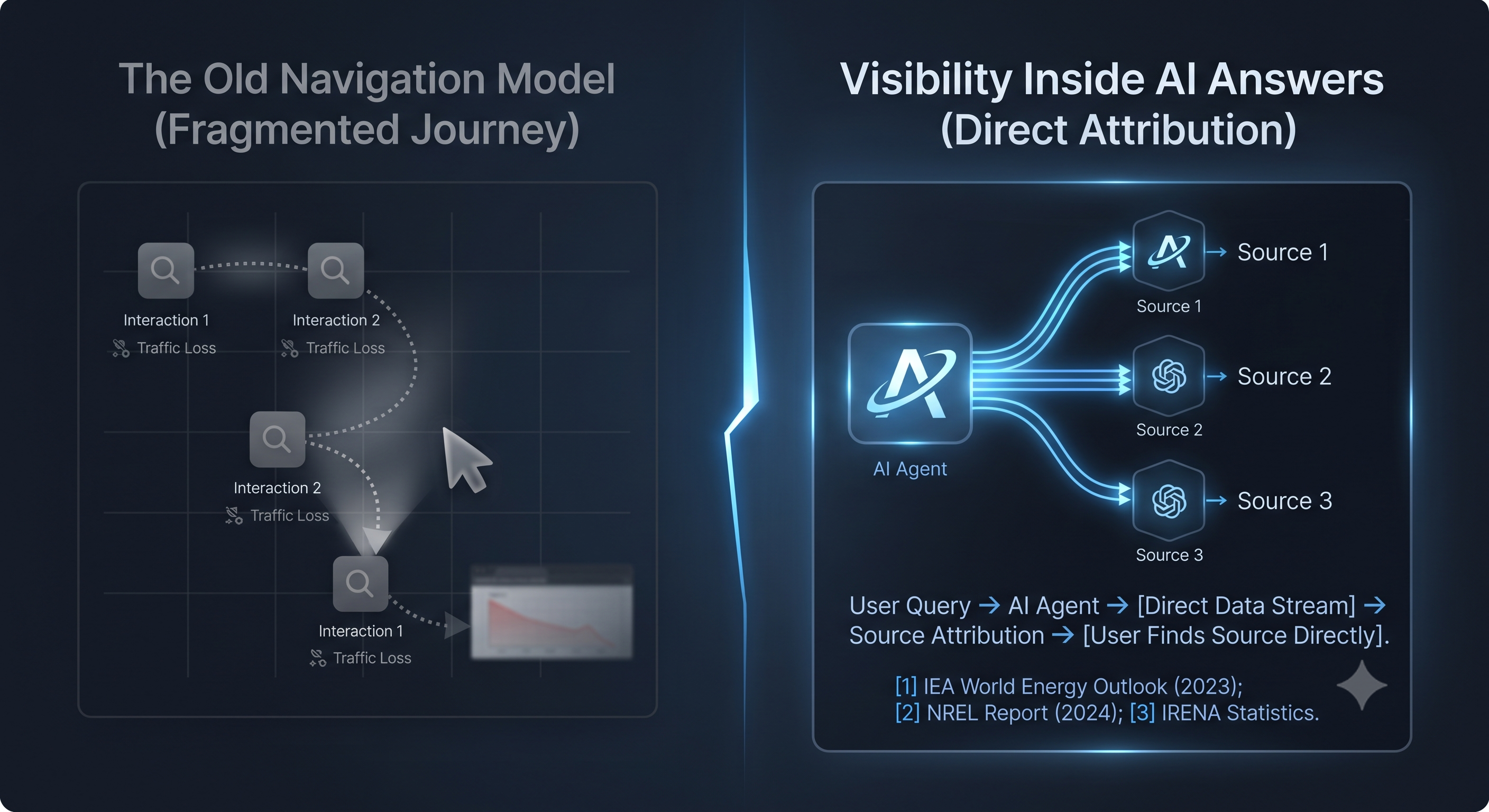
For years, search marketing has been measured by a familiar set of metrics: rankings, sessions, click-through rates, and conversions. Google's latest Search Console update suggests it's time to expand that framework - because the way value is created and measured is evolving faster than most scorecards have.
- Google's new AI Performance report in Search Console shows how content appears across AI Overviews, AI Mode, and Discover - and what's notable is what's missing: clicks.
- Roughly 68% of U.S. Google searches now end without a click, up from about 60% two years ago, as AI Overviews answer more queries directly on the page.
- Success in SEO is shifting from earning the click to becoming part of the answer itself - an important distinction most traffic metrics can't capture.
- BCG's recent CMO survey found nearly every marketing leader believes AI will reshape the function, yet only a small minority have implemented AI-native operating models. Technology is outpacing our management systems.
- Expand the scorecard: add brand presence in AI answers, citation frequency, share of AI visibility versus competitors, and GEO performance alongside traditional SEO.
The metric that went missing
Google's new AI Performance report gives marketers something they've been asking for: visibility into how their content shows up across AI Overviews, AI Mode, and Discover. It's a meaningful step toward understanding the AI-driven surfaces that increasingly sit between a query and a website.
But the most telling detail isn't what the report includes. It's what it leaves out. There's no click metric at the center of it. For a company whose entire measurement philosophy has been built around the click - impressions, position, click-through rate - that omission is a signal. Google is quietly acknowledging that a growing share of search value now happens before anyone leaves the results page, inside the answer itself.
The zero-click shift is already here
The data backs up the signal. Today, approximately 68% of Google searches in the U.S. end without a click - up from roughly 60% just two years ago. AI Overviews now appear in a meaningful share of searches, and users are increasingly consuming information directly within Google's AI-generated experiences rather than clicking through to a source.
This doesn't mean search is becoming less important. Search intent is as strong as ever - people are still asking, comparing, and deciding. What's changed is where that decision-making happens. More of it now takes place on the results page, inside an answer your brand may or may not be part of. The value didn't disappear. It moved to a place traditional analytics weren't built to see.
From earning the click to being the answer
For years, success in SEO was largely defined by earning the click. Rank well, write a compelling title, win the visit. That model still works - but it's no longer the whole game.
Increasingly, success also depends on whether your brand and content become part of the answer itself. When an AI Overview synthesizes a response, the question isn't only "did we rank?" It's "were we cited, quoted, or referenced in what the user actually read?" A brand can influence a buying decision now without ever receiving a session in Google Analytics.
That's an important distinction, and it reframes the goal. Many organizations are still evaluating search performance primarily through traffic metrics. Those metrics remain valuable - but on their own, they no longer tell the complete story.
Technology is outpacing the scorecard
The same pattern is emerging across marketing more broadly. BCG's recent survey of CMOs found that nearly every marketing leader believes AI will fundamentally reshape the function. Yet only a small minority have implemented AI-native operating models. Many teams continue to use generative AI as a productivity tool - faster drafts, quicker briefs - rather than rethinking workflows, measurement, and execution around it.
We've reached a point where the technology is advancing faster than our management systems. The capabilities are here; the scorecards, incentives, and reporting rhythms that would make sense of them mostly aren't. Closing that gap is a leadership problem before it's a tooling problem - and it starts with what we choose to measure.
The expanded SEO scorecard
As marketing leaders, we should begin expanding our scorecards alongside the technology itself. Traditional SEO metrics still matter - keep them. But they should be complemented by measures built for an AI-first search ecosystem:
- Brand presence within AI-generated answers. How often does your brand actually appear inside AI Overviews and AI Mode responses for the queries that matter to you?
- Citation frequency across AI search experiences. When AI answers cite sources, how often is one of them yours - and are you the reference, or a footnote to a competitor?
- Share of AI visibility relative to competitors. Presence isn't absolute; it's relative. Track your slice of the answer space against the players you compete with.
- GEO performance alongside traditional SEO. Measure Generative Engine Optimization - being surfaced and cited inside AI answers - as its own discipline, sitting next to your classic ranking and traffic reporting rather than replacing it.
How to start measuring AI visibility
Expanding the scorecard doesn't require rebuilding your analytics stack overnight. A few practical moves get you most of the way:
- Adopt the AI Performance report as a first-class dashboard. Treat AI Overviews, AI Mode, and Discover impressions as core visibility metrics, not a curiosity buried in Search Console.
- Establish a baseline for your priority queries. For the questions your buyers actually ask, check whether AI answers currently mention or cite you - and record it. You can't manage a share you've never measured.
- Structure content to be cited, not just crawled. Clear answers, well-labeled sections, FAQs, and structured data make it easier for AI systems to lift and attribute your content accurately.
- Report GEO and SEO side by side. Give AI visibility its own line in the monthly review so leadership sees influence and traffic together, not one at the expense of the other.
The next evolution
The organizations that adapt first won't necessarily be the ones generating the most traffic. They'll be the ones who understand how influence is being redistributed in an AI-first search ecosystem - and who build measurement systems that reflect that reality.
Marketing has always evolved alongside changes in consumer behavior. Search moved from ten blue links to rich results, from desktop to mobile, from keywords to intent. This is simply the next evolution: from earning the click to becoming the answer. The metrics we keep should follow the value - and right now, the value is moving into the answer itself.
FAQ
What is Google Search Console's new AI Performance report?
It's a Search Console view that shows how your content appears across AI-driven surfaces - AI Overviews, AI Mode, and Discover. The notable part is what it leaves out: clicks. That absence signals a shift from measuring traffic earned to measuring presence within AI-generated answers.
What percentage of Google searches end without a click?
Roughly 68% of Google searches in the U.S. now end without a click, up from about 60% two years earlier. As AI Overviews answer more queries directly on the results page, users increasingly get what they need without visiting a site - which is why click-based metrics alone no longer tell the full story.
How do you measure SEO when searches don't produce clicks?
Expand the scorecard beyond rankings, sessions, and CTR to include AI-era measures: brand presence within AI-generated answers, citation frequency across AI search experiences, share of AI visibility relative to competitors, and GEO (Generative Engine Optimization) performance alongside traditional SEO. These track whether your brand becomes part of the answer, not just whether it earns the click.
What is GEO (Generative Engine Optimization) and how does it differ from SEO?
GEO is the practice of optimizing content so it gets surfaced and cited inside AI-generated answers - AI Overviews, AI Mode, and LLM-based assistants. Traditional SEO optimizes to rank a link that earns a click; GEO optimizes to become part of the answer itself. In an AI-first search landscape the two work together, and both belong on the scorecard.
Why aren't traditional traffic metrics enough anymore?
Rankings, sessions, click-through rates, and conversions still matter, but they only capture value that arrives as a click. When most searches end without one and users consume answers directly inside AI experiences, traffic metrics miss the influence your brand exerts by being cited in the answer. On their own, they no longer tell the complete story.
If you're rethinking how your team measures search performance in an AI-first landscape, I'd be glad to compare notes.