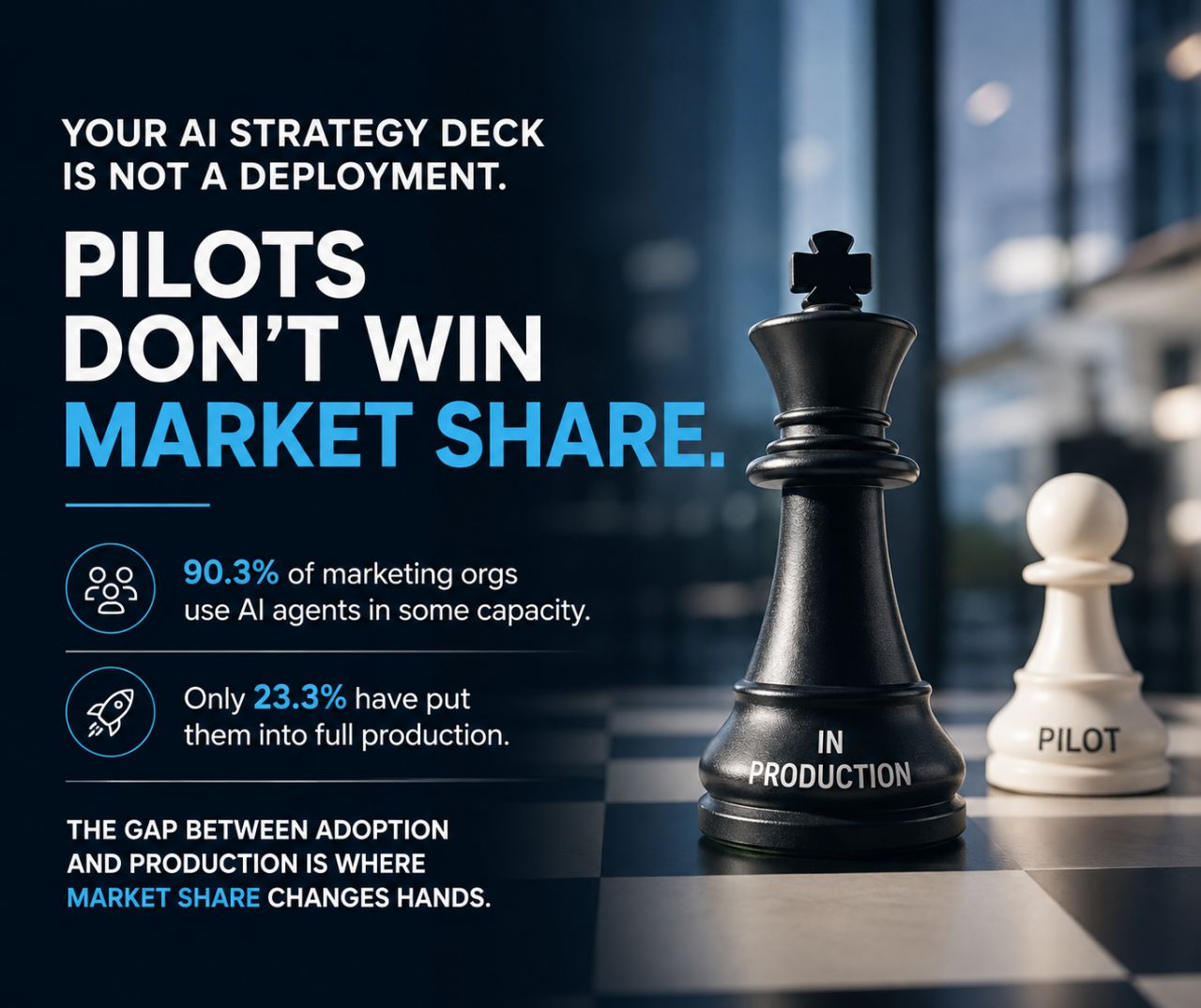
90.3% of marketing organizations use AI agents, but only 23.3% have them in production. Here's how to move from AI pilots to revenue-driving workflows.
- AI adoption is high, but AI production is still low: 90.3% of surveyed marketing organizations use AI agents, while only 23.3% have them fully in production.
- A pilot isn't an AI strategy. Experiments, roadmaps, committees, and proofs of concept don't create business value until AI is embedded in live workflows.
- AI platforms are already moving faster than marketing teams. ChatGPT and other platforms are building AI-driven product discovery, recommendations, advertising, attribution, and measurement into the customer journey.
- Customer discovery is changing: people increasingly ask AI systems to research products, compare options, and make recommendations before they ever visit a brand's website.
- The winners won't necessarily have the biggest AI budgets. They'll be the teams willing to take one high-value workflow and actually ship it.
- Good starting points include: AI-powered bidding, lifecycle automation, sales qualification, and AI search/GEO experiments.
- Measure AI by business impact, not activity: track AI-influenced budget, pipeline, revenue, customer journeys, productivity, and production workflows.
- Use a 90-day framework: define one workflow, build and test it, then put it into production and measure the result.
- The real competitive gap isn't AI adoption. It's AI execution.
- The question CMOs should ask: How much of our actual marketing is running with AI today—with real customers, real workflows, and real dollars behind it?
90.3% of marketing organizations are using AI agents. Only 23.3% have put them into full production. That gap may determine who wins the next phase of marketing.
There is a new way to look sophisticated in marketing.
Build an AI roadmap.
Create an AI task force.
Run a few pilots.
Add “AI transformation” to the quarterly strategy deck.
Then spend six months discussing governance, use cases, infrastructure, and what happens when you're finally ready.
The problem?
Your customers aren't waiting.
And neither are the platforms they already use to discover products, compare options, and make decisions.
The AI adoption number is impressive. The production number is the one that matters.
Research from Scott Brinker and Frans Riemersma's Martech for 2026 found that 90.3% of surveyed marketing organizations are using AI agents somewhere in their martech stack.
At first glance, that sounds like the industry has crossed the AI adoption threshold.
It hasn't.
Only 23.3% reported having AI agents in full production.
That leaves a massive gap between experimenting with AI and actually putting it to work.
And there's an important caveat: the survey respondents skew toward technically sophisticated marketing and martech leaders, meaning this is arguably a picture of the industry's leading edge rather than the average marketing department.
Even so, the signal is hard to ignore.
Marketing has moved rapidly from “Should we use AI?” to “We're using AI.”
But much of the industry hasn't made the much harder transition:
“AI is now responsible for something that matters to the business.”
That's the real shift.
A pilot is not production
There is nothing wrong with running an AI pilot.
Pilots are useful. They help teams understand capabilities, identify risks, test integrations, and build internal confidence.
The problem starts when the pilot becomes the destination.
A content-generation experiment that never connects to your publishing workflow is a pilot.
A lead-scoring experiment that never influences who sales contacts is a pilot.
An AI search experiment that produces a monthly report nobody acts on is a pilot.
An agent that recommends budget changes but never touches a live campaign is a pilot.
You can have 20 of these running simultaneously and still have almost no AI operating inside your actual business.
That's why the 23.3% number matters.
It forces a different question.
Not:
> How much AI are we experimenting with?
But:
> How much of our marketing actually runs with AI today?
Those are very different measurements.
The platforms are already building the infrastructure
While marketing teams debate their AI roadmaps, the platforms customers use to make decisions are changing underneath them.
ChatGPT is a particularly obvious example.
OpenAI has moved beyond conversational AI into product discovery and advertising infrastructure.
Its product-discovery experience allows users to browse products, compare options, and refine recommendations conversationally. OpenAI has also expanded its Agentic Commerce Protocol to connect merchant product data with ChatGPT.
And the advertising layer is becoming increasingly sophisticated.
OpenAI introduced CPC bidding, Ads Manager, conversion measurement through the Conversions API and pixel-based measurement, and additional campaign-management capabilities in 2026.
As of August 2026, ChatGPT Ads had reached a $1 billion annualized revenue run rate, with OpenAI saying the platform was being used by tens of thousands of advertisers and was available in more than 40 countries.
This is not a five-year roadmap.
It's infrastructure being built now.
And it changes the role marketing plays inside these environments.
Your customer journey is moving upstream
For years, marketers optimized for a relatively familiar journey:
Search → website → landing page → conversion
AI-driven discovery introduces another layer:
Question → AI recommendation → consideration → decision
The website may still matter.
Google still matters.
Paid media still matters.
But the first meaningful interaction with a brand increasingly doesn't have to happen on the brand's own property.
Someone can ask an AI:
> “What's the best project management software for a 50-person agency?”
Or:
> “Which CRM should I use if I need strong automation but don't have a dedicated RevOps team?”
Or:
> “Find me a running shoe under $150 for long-distance training.”
The platform can interpret the request, understand the constraints, compare options, and surface recommendations.
That creates a new marketing problem.
How does your brand become one of the options?
And once you're there:
Why does the AI recommend you over the alternatives?
That's not traditional SEO.
It's not traditional paid acquisition either.
It's increasingly about becoming legible, relevant, trusted, and useful inside AI-mediated discovery.
The winners won't necessarily have the biggest AI budgets
This is where I think many companies are going to make the wrong move.
They'll assume AI maturity means spending more.
More tools.
More models.
More consultants.
More data infrastructure.
More AI specialists.
More pilots.
But the companies that move fastest may not be the ones with the biggest budgets.
They'll be the ones willing to take a single workflow and push it all the way into production.
For example:
1. An AI-powered bidding workflow
Don't build a presentation explaining how AI could eventually optimize paid media.
Take one campaign.
Give an agent access to the relevant performance data.
Define the boundaries.
Set approval rules.
Measure incremental performance.
Then run it.
2. A lifecycle marketing agent
Instead of using AI to write another batch of emails, connect an agent to customer behavior.
Let it identify a meaningful trigger.
Generate the appropriate action.
Launch the workflow.
Measure activation, retention, conversion, or revenue.
Now AI isn't producing content.
It's operating part of the customer journey.
3. An AI search optimization experiment
Don't create another 40-page GEO strategy document.
Pick 20 commercially important questions.
Track whether your brand appears.
Identify what information influences the answers.
Improve your product data, content, reviews, third-party presence, and technical signals.
Measure changes over time.
That's an actual experiment.
4. A sales qualification agent
Give an agent a defined ICP.
Connect it to your CRM and enrichment sources.
Let it evaluate inbound leads against explicit criteria.
Route qualified prospects.
Flag edge cases for humans.
Measure qualified pipeline, not how many leads the agent processed.
That's production.
Production changes the conversation
This is the part that gets uncomfortable.
A pilot can always be explained.
If it doesn't work, you can say:
“We learned a lot.”
Production doesn't give you that luxury.
Production tells you whether the thing actually works.
Did conversion improve?
Did CPA decline?
Did sales accept the leads?
Did pipeline increase?
Did customers respond?
Did the agent make mistakes?
Did humans spend less time on the workflow?
Did revenue move?
That's why production is harder.
And that's precisely why it's valuable.
The objective of AI transformation isn't to create more AI activity.
It's to create more business value per unit of human effort, data, and capital.
Stop measuring AI maturity by the number of pilots
This may require marketing leaders to rethink their AI dashboards.
Instead of reporting:
- Number of AI tools adopted
- Number of AI pilots launched
- Number of employees using ChatGPT
- Number of AI use cases identified
- Number of AI workshops completed
Start measuring:
- % of marketing budget influenced by AI
- % of customer journeys containing AI-driven decisions
- % of qualified pipeline influenced by AI
- Revenue generated or influenced by AI workflows
- Hours of human work removed from recurring processes
- AI-assisted vs. AI-executed workflows
- Production AI workflows with measurable business outcomes
- Time from AI idea to production
Those metrics tell you something much more useful.
They tell you whether AI is becoming part of the operating model.
The 90-day AI production challenge
Marketing teams don't need to automate everything.
They need to prove that one thing works.
Pick a workflow with three characteristics:
It happens frequently.
If the process occurs once a quarter, it's probably not your best first agent.
It has a measurable business outcome.
Revenue, pipeline, conversion, cost, speed, retention, or productivity.
It can be safely constrained.
You should know what the agent can do, what it cannot do, and when a human needs to intervene.
Then give the team 90 days.
Days 1–30: Define
Choose the workflow.
Document the current process.
Identify the inputs, systems, decisions, and outputs.
Define the baseline KPI.
Set the guardrails.
Days 31–60: Build
Connect the necessary data and tools.
Create the workflow.
Test it against historical examples.
Add human approval where necessary.
Start measuring failure modes.
Days 61–90: Ship
Put it into a real production environment.
Give it real work.
Track real outcomes.
Compare performance against the baseline.
Then make a decision:
Scale it, change it, or kill it.
All three outcomes are better than another six months in pilot mode.
The real AI maturity metric
The biggest mistake marketers can make in 2026 is confusing AI adoption with AI maturity.
Adoption tells you that people are using the technology.
Production tells you that the organization has figured out how to make it useful.
Governance.
Data.
Integrations.
Workflows.
Measurement.
Human oversight.
Ownership.
Those are the boring parts of AI.
They're also the parts that determine whether an AI strategy becomes an operating advantage.
The 90.3% figure tells us AI agents have entered the mainstream of marketing experimentation.
The 23.3% figure tells us the race isn't over.
In fact, it may be just beginning.
Because when most companies have experimented with the same technology, experimentation stops being much of a competitive advantage.
Execution becomes the advantage.
Your customers don't care whether your AI strategy has been approved by the steering committee.
They care whether your brand is easy to discover.
Whether your product is relevant.
Whether your answer is useful.
Whether the experience is fast.
Whether you solve their problem.
And increasingly, AI systems will sit between your brand and that decision.
So don't ask how many AI pilots your marketing team has running.
Ask a harder question:
How much of your actual marketing is running with AI today, with real customers, real workflows, and real dollars behind it?
Because the gap between AI adoption and AI production isn't just a technology gap.
It's where market share is going to change hands.
FAQ
What percentage of marketing organizations use AI agents?
According to Scott Brinker and Frans Riemersma's Martech for 2026 research, 90.3% of surveyed marketing organizations reported using AI agents somewhere in their martech stack. The survey sample skews toward technically sophisticated organizations.
What percentage of marketing organizations have AI agents in production?
23.3% of surveyed marketing organizations reported having AI agents in full production.
What is the difference between AI adoption and AI production?
AI adoption means an organization is using or experimenting with AI. AI production means AI is integrated into a live business workflow, operating under defined controls and contributing to a measurable outcome.
How should marketing teams measure AI maturity?
Measure production workflows, AI-influenced budget, pipeline and revenue, automated customer journeys, human effort removed, workflow performance, and time from AI experiment to production, not simply the number of AI tools or pilots.
How can marketing teams move AI from pilot to production?
Choose one recurring workflow with a measurable business outcome, establish data and governance requirements, build the workflow, test it, and deploy it within a defined period such as 90 days.
If your organization has plenty of AI pilots but too few AI workflows running in production, I’d be happy to compare notes on how to turn experimentation into measurable marketing performance. Let's Talk.