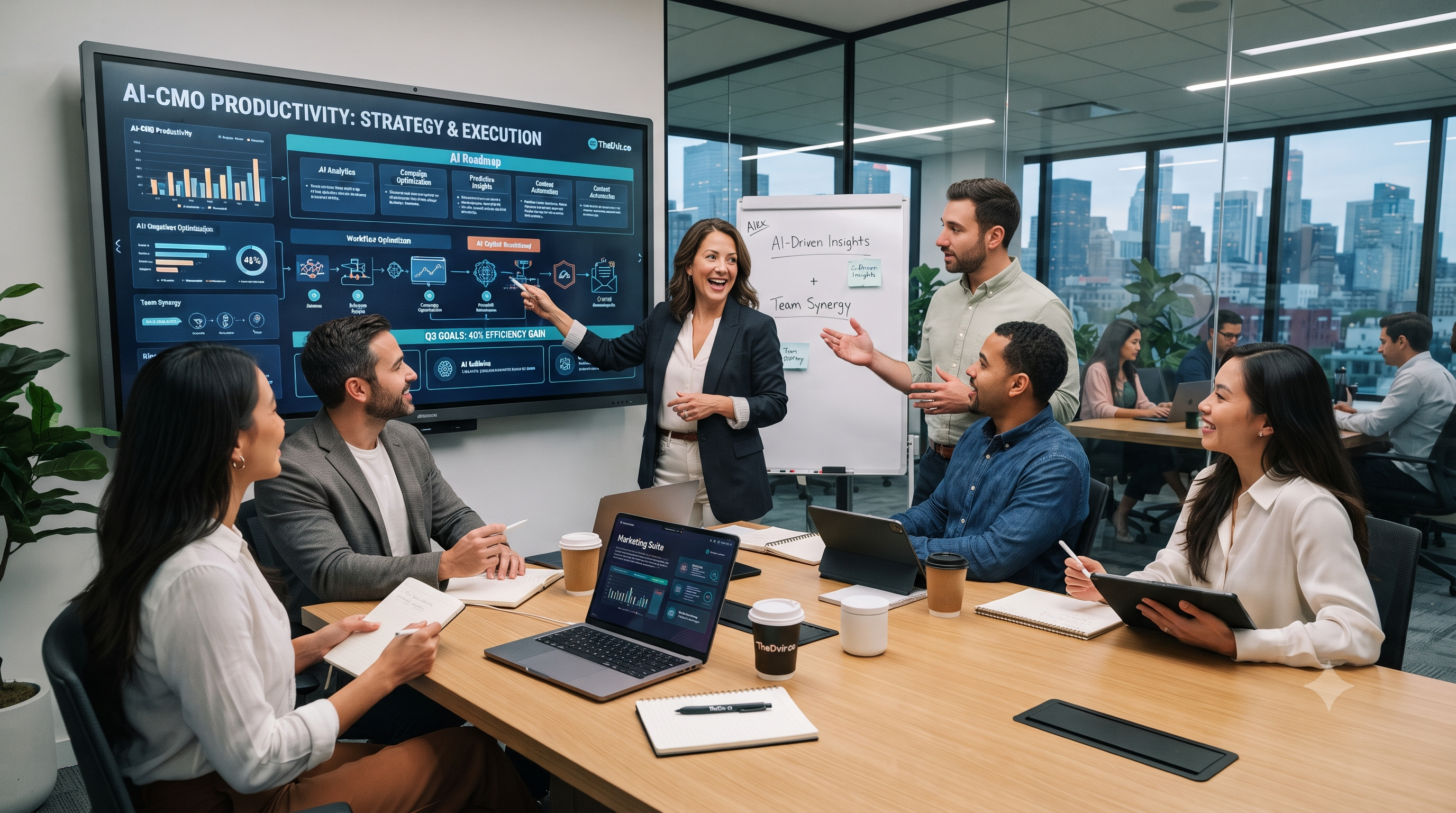
Most CMOs think AI's productivity win is faster copy. The real win shows up somewhere else first - in how a team brainstorms, not how fast it writes.
- AI's biggest productivity gain for a CMO isn't writing speed - it's compressing the loop between strategy, execution, and measurement.
- Brainstorms improve when AI is treated as a participant with real context (ICP, past performance, competitor messaging) - not a blank-prompt idea machine.
- The highest-leverage move is using AI to widen the pool of ideas fast, then letting the team do the judgment and narrowing.
- The CMOs who get the most out of AI treat it as an operating-system change for the team, not a tool swap.
The real productivity bottleneck isn't writing speed
Every vendor pitch about AI and marketing leads with the same promise: write ten times more content, ten times faster. It's true, and it's also not where the actual bottleneck lives for most teams I've run or advised.
The bottleneck is decision latency - the time between "we have an idea" and "we know if it worked." It's the context-switching between strategy docs, creative reviews, and stakeholder approvals. It's a brainstorm that produces twelve mediocre ideas because everyone anchored on the first person who spoke. Faster drafting doesn't fix any of that on its own. Compressing the whole loop does.
Where AI actually compresses the marketing cycle
When I re-engineered the marketing stack at CommPeak / Riset around GenAI tools, the time saved on writing was real but secondary. The bigger shift was upstream and downstream of the writing:
- Strategy and planning - using AI as a thinking partner to stress-test GTM plans and messaging frameworks before they reach a room full of stakeholders, so the first draft of a strategy doc is already a fifth draft.
- Research and synthesis - pulling signal out of sales calls, reviews, competitor content, and community discussion in minutes instead of days, so positioning decisions are based on this quarter's reality, not last year's research.
- Execution - campaign briefs, landing page variants, and ad copy that go from brief to build in hours, which matters less for the hours saved than for how many more ideas you can afford to test.
- Measurement and iteration - shortening the hypothesis-to-test loop so campaigns get better in weeks, not quarters.
Put together, that's the actual productivity story: not "we write faster," but "we complete more strategy-to-result loops per quarter."
Turning team brainstorms into something AI actually helps with
This is where most teams get AI-assisted brainstorming wrong. They open a blank prompt, type "give me campaign ideas for X," and get back generic, forgettable output - then conclude AI isn't useful for creative work. The fix isn't a better tool. It's giving AI a real seat at the table.
- Feed it context, not a blank prompt. Give the model your ICP, last quarter's top and bottom performing campaigns, and actual competitor messaging before you ask for ideas. Constraints produce better ideas than open-ended prompts, for AI and for people.
- Use AI to widen before the team narrows. Have it generate a wide first pass - twenty rough directions in ten minutes - then let the human team do what humans are actually good at: judgment, taste, and knowing which three are worth pursuing.
- Run "AI vs. team" rounds. Have the model produce a first pass on a brief before the meeting. The team's job in the room becomes critiquing and rebuilding it, which is a faster and more honest starting point than staring at a blank whiteboard.
- Assign AI a role in the room. A skeptical customer, a budget-constrained buyer, a competitor's CMO reacting to your campaign - using AI to pressure-test an idea from an adversarial angle catches weak points a friendly internal room tends to miss.
- Keep a living context file. Document the brand voice, ICP, and decisions from past brainstorms in a file you feed back into every session, so the team isn't re-explaining the same context every time and the next brainstorm starts several steps ahead.
What this means for CMO productivity, concretely
Done well, this changes where a marketing leader's time goes:
- Less time producing first drafts, more time on strategy, coaching, and stakeholder alignment - the parts of the job that don't compress no matter how good the tools get.
- Faster GTM iteration cycles, because testing a hypothesis costs less in time and headcount than it used to.
- Smaller teams covering more ground without the burnout that comes from just asking people to "do more."
Where AI-assisted brainstorming breaks down
It's worth being honest about the failure modes, because they're common and avoidable:
- Groupthink, accelerated. If everyone in the room anchors on the AI's first draft instead of the model's output being one input among several, you get consensus faster - around a mediocre idea.
- Losing taste. AI is very good at combinatorics - recombining what's already been said. It's not a substitute for the conviction and point of view that make a campaign actually stand out.
- Drift from brand voice and facts. Without guardrails - a real style guide, real product facts fed in as context - AI output drifts generic fast, and someone still has to catch it before it ships.
The mindset shift for marketing leaders
My background is in industrial engineering before it was in marketing, and the lens that's carried over is this: a marketing organization is a system, not a series of campaigns. AI doesn't change that - it changes how fast the system can run, and how many more ideas it can afford to test before committing budget. The CMOs who get the most out of it aren't the ones who adopted a new tool. They're the ones who redesigned the system around it.
FAQ
Does AI replace the CMO's job?
No. It removes friction from the parts of the job that are mechanical - first drafts, research synthesis, variant generation - and gives back time for the parts that require judgment, taste, and relationships, which AI still can't do.
What's the best way to start using AI in team brainstorms?
Start small: bring real context (ICP, past campaign data, competitor messaging) into a single session, have AI generate a wide first pass, and let the team spend the meeting critiquing and narrowing instead of generating from scratch. Measure whether the output quality and speed actually improved before rolling it out further.
Do I need special tools, or can I just use ChatGPT or Claude?
You can start with general-purpose tools like Claude, ChatGPT, or Gemini and real context fed in manually - that's genuinely enough to see the productivity gain. Purpose-built marketing tools help at scale, but the habits and process matter more than the tool.
How do I keep brand voice consistent when AI is involved?
Maintain a living style guide and context file - real examples of on-brand and off-brand copy, not just adjectives - and feed it into every session. Someone on the team still needs to own final review; AI output should be a fast first pass, not the final word.
If you're rethinking how your marketing team works with AI, I'd be glad to compare notes.